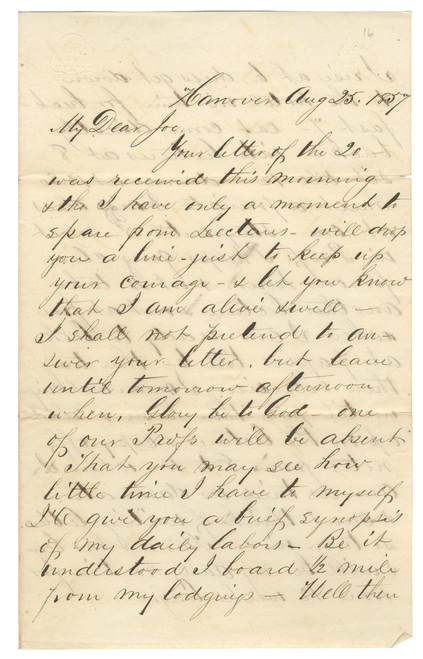


A compelling and content-rich four-page autograph letter signed (S.C. Bryant), dated December 30, 1839, written from Andover Theological Seminary, Massachusetts to a young correspondent, “Abby.” Historical & Content Highlights: Seminary & religious training insight: The writer reflects candidly on preparing for the ministry, describing it as a “solemn & awful” responsibility—an evocative glimpse into 19th-century theological education. Detailed winter disaster account: Includes a dramatic narrative of an elderly blind woman led into the woods during a severe snowstorm by a mentally unstable companion—ending tragically. A vivid example of period rural hardship and mental illness. Public health concerns: Mentions smallpox fears and vaccination efforts, documenting real-time community response to epidemic threats in antebellum New England. Industrial accident reference: Describes a powder mill explosion in Acton, Massachusetts, whose shock was felt miles away—illustrating early industrial hazards. Social & educational commentary: Offers thoughtful advice on study habits, perseverance, and intellectual discipline—valuable insight into 19th-century pedagogy and moral instruction. Personal tone: Warm, reflective correspondence filled with family references, travel commentary (Salem), and daily life—highly engaging and readable. Physical Description: Four-page folded letter, written in clear brown ink. Typical mailing folds, light toning, minor staining, and a few small separations at fold lines. Address panel with postal markings on verso. Overall very good condition with strong legibility. Collector Appeal Ideal for collectors of: Early American religious and educational history Andover Theological Seminary material 19th-century manuscript letters with narrative content Public health (smallpox) and disaster accounts New England social history.
| Trancription: |
My dear little Abby, Pardon me for calling you little, especially after the young gentlemen of Andover have titled you as lady. I remember very well you was little once, and I thought I would just call you so again, in memory of old times. I am well aware it is not customary to call ladies little, but I don’t stand for custom when writing to old friends. Here is that long promised letter that you have more than once gently reminded me of. I write now that you may get this about New Year, as a New Year’s gift—a poor one indeed, but the best I can send by mail. I take this opportunity to wish you “a happy New Year” when it comes. The old year has been a pleasant one to me—I hope it has to you too. Where shall we be at the close of the next year—if we live? You will be in Mount Vernon, in the cheerful and happy home of your childhood. Where I shall then be, and what my situation will be, is known only to God. Before that time I shall be thrown on the wide world to perform my part in its business and its duties. It is a solemn & awful thought, to think of being a minister and of preaching to my fellow men. As the time draws nearer, the work appears more & more awful and I feel more than ever unprepared to commence. I was very glad to visit you & your folks in Andover so soon after my return. It seemed almost like being at home, to sit down with so many of your family. You can scarcely conceive how pleasant it is to meet old friends when one is far away from home. Harriet, I presume, can tell you it is cheering to the spirits to have an old acquaintance occasionally drop in. And you will be able to appreciate such interviews, if you are ever called to leave your home and feel that you are a stranger among strangers. Probably you saw a great many fine things at Salem. You must write soon & give me an account of what you saw, & tell me if Salem is worth going 14 miles to see. I have never been there. If you think I should be enough to pay me for going, perhaps I shall take some leisure day & go down there. You recollect what a storm we had about 2 weeks ago. It began to snow Saturday night & stormed till Monday night. There were two old women living together in a small house about a mile & a half from the Seminary. One was near 90 years old & was perfectly blind. The other, whose name was Harris, was somewhat deranged. She had appeared rather strange, & was suspected to be partially insane. That stormy Saturday night she wrapped the old lady in a blanket, furnished her with provisions, & led her off into the woods. In the morning she went to a neighbor’s & told them what she had done. The reason she assigned for doing this was, that she was afraid “Old Clark” would kill her. Old Clark is a near neighbor & had done considerable towards sustaining them. People were out searching for the woman all day Sunday, but could not find her. The search was renewed on Monday without success. On Tuesday most of the students went to search for her. There were about 200 persons engaged, including about 40 women. She was not found yet. She did not return to Harriet. Sabbath night she slept where she was lodging, travelled about 3 miles & was found the next morning about 3 rods from a house, dead. She had nothing on but her night clothes. A few days ago it was reported that the small pox was in town. Some of the people were very much alarmed. They flocked in crowds to the physicians to be vaccinated. There was a few cases of the small pox in Reading, a town adjoining this, but none in Andover. Last week we sent for a doctor who came up to the Seminary and vaccinated most of the students. The small pox has been in Boston some time past, and is now spreading in many towns in different parts of the state. A few days ago a powder-mill was blown up in Acton, Mass. We heard the report & felt the shock very distinctly at the Seminary. Our windows rattled as if in an earthquake. One man was killed. No one exposed there escaped death. We can never be secure from its attacks. Our only safety is in being always prepared to meet it. I suppose you and John are attending school this winter. What are you both studying? Who keeps your school this winter? Where is William? Where is Harriet? Where is Clarissa? John Pierce? Elizabeth B. Elizabeth Clement? the Miss Randall? Horace? Mr. Richardson? &c. &c.? How is Mr. Gunnison’s health? Where is Henry Kendall? I have here a long list of questions. I could ask as many more but that I fear you would be tired of them. Now I wish you would write soon & tell me all the news. Write just as you would talk if you were to come into my room & sit down by the stove & have a chat for an hour & a half. I have not heard from Mount Vernon since you were here, and do not know but you are all buried up in the snow drifts. If so I hope you will come out in good health & spirits in the spring. You must improve well what time you have for school. Don’t be afraid to study long & hard. I think little girls don’t very often hurt themselves with hard study—or great girls either. You must not think me pedantic—you know the present company is always excepted. If you find any lessons difficult to understand, study them till they become easy. Don’t throw them aside because they are hard. One thought well mastered is worth more than a hundred that are half understood. Simple divisions I worked day after day on a question that was worked out in the book, & could not understand how it was done. I rubbed my head & bit my pencil; made figures & rubbed them out—sometimes grew impatient & fretful as other naughty children do—carried the question to the master; he showed me how to do it & thought it a very easy question. I thought it easy for him, but not for me. So I could not do it even after he had shown me how. Now I can do that question. If you are persevering, you will overcome difficulties in the same way. But you may say your difficulties are harder than those. Very well; then go with resolution through the hard difficulties, if you have conquered the easy ones. I have known that questions much harder than that, but if you have not overcome the less difficulty, I certainly should not have overcome the greater. Give my kind regards to your father’s family & to Mr. Goodrich’s folks, if you please. Tell John I shall send him a Catalogue in a few days, as soon as they are printed. Your affectionate friend, S. C. Bryant