
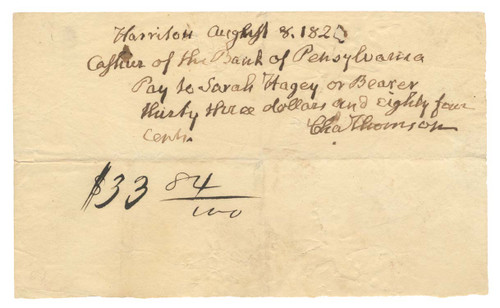
Autograph bank draft signed “Cha. Thomson,” Harriton, Pennsylvania, August 8, 1820, directing the Cashier of the Bank of Pennsylvania to pay Sarah Hagey or bearer the sum of $33.84. This appealing financial document bears the signature of Charles Thomson (1729–1824), one of the most important yet often overlooked figures of the American Revolution. Written at Harriton, his country estate in Montgomery County, Pennsylvania, on August 8, 1820, the draft orders the Cashier of the Bank of Pennsylvania to pay Sarah Hagey or Bearer the sum of thirty-three dollars and eighty-four cents. Though modest in amount, the document is historically significant because it dates from the final years of Thomson's long life and preserves the autograph of the man who served as the Secretary of the Continental Congress for fifteen consecutive years, making him one of the central administrative figures of the American Revolution. Few individuals were more intimately connected with the day-to-day operations of the Revolutionary government. The draft reads: “Cashier of the Bank of Pennsylvania Pay to Sarah Hagey or Bearer Thirty Three dollars and Eighty four Cents.” The instrument was executed at Harriton, the estate where Thomson spent much of his retirement. Having withdrawn from public life after the establishment of the federal government, he devoted himself to scholarship, agriculture, and biblical studies. Documents from this later period are especially desirable because they connect directly to the final chapter of the life of a founder whose contributions to American independence were immense yet largely behind the scenes. Born in Ireland in 1729, Charles Thomson immigrated to Pennsylvania as a child and rose to prominence as a merchant, political activist, and advocate for colonial rights. By the early 1770s he had become a respected leader within Philadelphia's Patriot movement and was deeply involved in resistance to British policies. In 1774 the First Continental Congress elected Thomson as its secretary, a position he would hold continuously through both the Revolution and the Confederation period until 1789. His tenure spanned the entirety of the struggle for independence and the formative years of the United States under the Articles of Confederation. As secretary, Thomson occupied a uniquely important position. He recorded congressional proceedings, maintained official records, prepared correspondence, authenticated public documents, and ensured continuity in the operations of Congress despite constant political and military upheaval. He worked closely with virtually every major figure of the Revolutionary generation, including George Washington, John Adams, Thomas Jefferson, Benjamin Franklin, John Hancock, and Robert Morris. Perhaps most notably, it was Charles Thomson who officially transmitted the Declaration of Independence to the states after its adoption in July 1776. His name appears alongside that of President John Hancock on the earliest official printed versions of the Declaration distributed throughout the colonies. Through his stewardship of congressional records, Thomson became one of the principal custodians of the documentary history of the Revolution. Following the adoption of the Constitution, Thomson declined further public office and retired from political life. Unlike many founders, he never sought prominence in the new federal government. Instead, he devoted his later years to intellectual pursuits, producing a respected translation of the Septuagint and engaging in agricultural experimentation at Harriton. Because Thomson's public role was primarily administrative rather than political, surviving signed documents are considerably scarcer than those of many more famous founders. Yet historians increasingly recognize that without Thomson's diligence and organizational ability, the Continental Congress could not have functioned as effectively during the Revolution. This 1820 draft is especially appealing because it was executed at Harriton only four years before Thomson's death in 1824. It therefore represents a late-life financial document signed by one of the indispensable administrators of American independence. Combining an attractive autograph, identifiable recipient, and direct association with Thomson's retirement estate, it provides a tangible connection to the man often remembered as the “Samuel Pepys of the American Revolution” for his unparalleled knowledge of congressional affairs. As a result, the document stands as both a collectible autograph of a Founding Father and an evocative artifact of the generation that guided the United States from colonial resistance to independent nationhood. ______________________________________________________________________________________________
Harriton August 8, 1820 Cashier of the Bank of Pennsylvania Pay to Sarah Hagey or Bearer Thirty Three dollars and Eighty four Cents. Cha. Thomson $33.84