


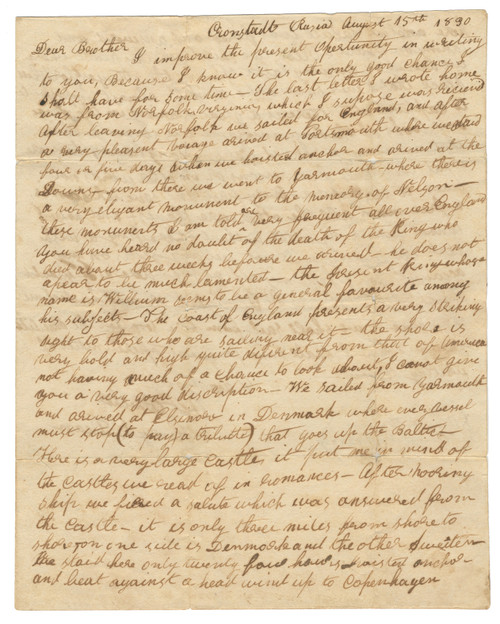
A highly engaging autograph letter signed (Henry L. Dean), dated August 15, 1830, written from Cronstadt (Kronstadt), Russia, offering a vivid first-hand account of a transatlantic and Baltic voyage during the early 19th century. Key Historical Features Extensive travel narrative: Chronicles a journey from Norfolk, Virginia → England → Denmark → Russia, providing rare insight into early 19th-century maritime routes. England during royal transition: Mentions the recent death of King George IV and accession of King William IV, noting public sentiment—valuable contemporary commentary. Baltic Sea trade & toll system: Describes stopping at Elsinore (Helsingør) to pay the famous Sound Dues, a critical aspect of European maritime commerce. Military & strategic observations: Provides an eyewitness impression of Cronstadt as a heavily fortified Russian naval stronghold, emphasizing its perceived impregnability. Cultural observations of Russia: Notes distinctions in appearance and social status, including references to beards and perceived class divisions under the Tsarist system. Naval customs: Includes references to firing salutes, pilot boarding, and navigation conditions—useful for maritime historians. Period endorsement: Retains docketing noting receipt date (“Nov. 12, 1830”), enhancing authenticity and postal history interest. Physical Description Single folded letter with integral address leaf. Toning, fold wear, and some staining consistent with age and transcontinental travel. Handwriting clear and legible throughout. Address panel present with period markings. Collector Appeal An exceptional piece for collectors of: Maritime and naval history Early American travelers abroad Baltic and Russian Imperial history 19th-century correspondence with detailed travel content Anglo-American historical relations A rich, narrative-driven letter combining travel, politics, and cultural observation—far more substantive than typical correspondence of the period.
| Transcription: |
Dear Brother, I improve the present opportunity in writing to you, because I know it is the only good chance I shall have for some time. The last letter I wrote home was from Norfolk, Virginia, which I suppose was received after leaving Norfolk we sailed for England, and after a very pleasant voyage arrived at Portsmouth where we staid four or five days, when we hove up anchor and arrived at the Downs, from thence we went to Yarmouth where there is a very elegant monument to the memory of Nelson—these monuments I am told are very frequent all over England. You have heard no doubt of the death of the King who died about three weeks before we arrived—he does not appear to be much lamented—the present King whose name is William seems to be a general favourite among his subjects. The coast of England presents a very striking sight to those who are sailing near it—the shore is very bold and high quite different from that of America not having much of a chance to look around I cannot give you a very good description. We sailed from Yarmouth and arrived at Elsinore in Denmark where every vessel must stop (to pay a tribute) that goes up the Baltic. Here is a very large Castle, it put me in mind of the Castles we read of in romances—after mooring ship we fired a salute which was answered from the Castle—it is only three miles from shore to shore, one side is Denmark and the other Sweden—we staid here only twenty four hours, and beat against a head wind up to Copenhagen. Here another salute was fired and answered, and taking on board a Pilot we sailed for this place where we arrived on Monday last. This is the strongest fortified place that I ever saw and I think it almost impossible to capture it—there is a great variety in the dress and looks of the Russians—some we see with chins that never were shaved having long beards, these are what they call free persons or in other words not slaves to the Emperor—every first and second serve with beards—a free man all the others are slaves. And now I cannot finish my letter without expressing a wish that the family will not feel any fears on my account, for I feel myself as safe here as I should be at home, having an Almighty arm to protect me the same—we shall sail from here soon for the Mediterranean where I shall have frequent opportunities of writing to you. I am your Affectionate Brother Henry L. Dean


