


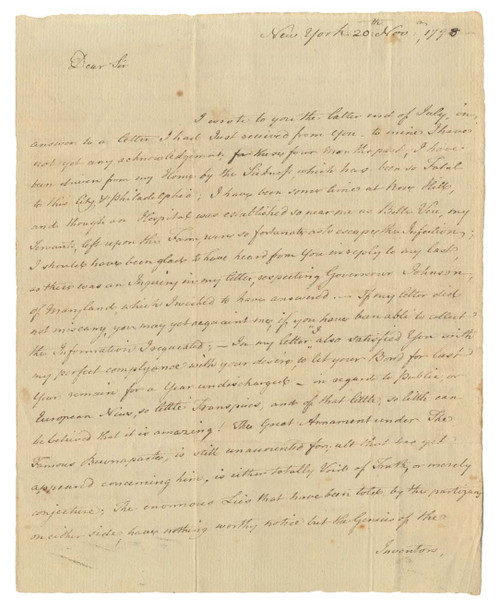
Autograph Letter Signed, Horatio Gates, New York, 20 October 1798, four pages, written to an unidentified correspondent. In this remarkable and wide-ranging letter, Revolutionary War Major General Horatio Gates discusses the devastating yellow fever epidemic that had recently swept New York and Philadelphia, comments on the rise of Napoleon Bonaparte, analyzes the failed French expedition to Ireland, and reflects upon political conditions in Europe during the turbulent years of the French Revolutionary Wars. Writing after months of disruption caused by disease, Gates explains that he had been unable to correspond because he had been driven from his home by “the sickness which has been so fatal to this city & Philadelphia.” He notes that he spent time at Rose Hill and that his household fortunately escaped infection. The epidemic to which Gates refers was one of the recurrent yellow fever outbreaks that periodically devastated American cities in the 1790s, causing widespread mortality and temporary flight from urban centers. The letter is particularly notable for its observations on contemporary international affairs. Gates remarks upon the difficulty of obtaining reliable information concerning Napoleon Bonaparte, whose meteoric rise had captivated Europe and America alike. He writes that “The Great Armament under the Famous Buonaparte, is still unaccounted for,” reflecting the uncertainty surrounding Napoleon’s Egyptian campaign of 1798 and the limited speed with which transatlantic news traveled. Gates complains that reports concerning Bonaparte are clouded by rumor and partisan exaggeration, noting that “the enormous Lies that have been told by the partizans” obscure the truth. Gates also discusses the French-supported Irish rebellion of 1798 and the failed French expedition commanded by General Humbert and later General Hoche, observing that events in Ireland had disappointed advocates of liberty and reform. His comments provide a valuable American perspective on the interconnected revolutionary movements that shook the Atlantic world at the close of the eighteenth century. The document therefore combines firsthand observations on public health, international politics, military affairs, and the flow of information in the early republic, making it a significant surviving letter from one of the most famous officers of the American Revolution. By October 1798 the United States found itself deeply affected by events occurring both at home and abroad. The devastating yellow fever epidemics of the decade repeatedly disrupted commerce and government, while the Quasi-War with France heightened public attention to European developments. Gates, long retired from active military service, remained an attentive observer of world affairs and maintained an extensive correspondence network. The letter vividly captures the uncertainty of the era. News from Europe often arrived months late and was colored by political loyalties. Napoleon's invasion of Egypt had generated widespread speculation, while the failed Irish uprising of 1798 raised hopes and fears among supporters and opponents of revolutionary movements throughout the Atlantic world. Gates's skepticism toward sensational reports demonstrates the challenges of assessing international events before modern communications. Equally significant is the letter's reference to yellow fever. Epidemics shaped political and social life in the early republic as profoundly as military and diplomatic events. Gates's description of fleeing the city to avoid contagion mirrors the experience of thousands of Americans during the crisis years of the 1790s. Horatio Gates was one of the most prominent military figures of the American Revolution. Born in England around 1727, he entered the British Army as a young man and served in North America during the French and Indian War. There he became acquainted with George Washington, a relationship that would later prove important during the Revolutionary era. After settling in Virginia following his British military service, Gates embraced the American cause at the outbreak of the Revolution. In 1775 the Continental Congress appointed him a brigadier general and adjutant general of the Continental Army. He quickly became one of the most influential officers in American service. Gates achieved lasting fame through his command during the Saratoga Campaign of 1777, culminating in the surrender of British General John Burgoyne. The American victory at Saratoga is widely regarded as the turning point of the Revolution because it helped secure French recognition and military support for the United States. Despite this success, Gates's career later suffered setbacks. His association with critics of Washington during the so-called “Conway Cabal” damaged his reputation, and his disastrous defeat at the Battle of Camden in 1780 further diminished his military standing. Nevertheless, he remained a respected public figure and continued to participate in national affairs after the war. In retirement Gates divided his time between New York and Virginia, corresponding with leading political and military figures. He died in New York City in 1806. Today he is remembered as one of the principal generals of the Continental Army and as the victor of Saratoga, whose success helped secure American independence. ______________________________________________________________________________________________
New York, the 20th Novr, 1798 Dear Sir I wrote to you the latter end of July, in answer to a letter I had Just received from you to mine I have not yet any acknowledgment, for these four months past, I have been driven from my Home by the Sickness which has been so fatal to this City & Philadelphia; I have been sometimes at Rose Hill, and though an Hospital was established so near me as Belle Vue, my Servants, left upon the Farm, were so fortunate as to escape the Infection; I should have been glad to have heard from you in reply to my last, as there was an Inquiry in my letter respecting Governor Johnson of Maryland, which I wished to have answered. — If my letter did not miscarry, you may yet acquaint me, if you have been able to collect the information I requested; — In my letter also ratified you with my perfect compliances with your desire to let your Bond for last year remain for a year undischarged — in regard to public or European News, so little transpires, and of that little, so little can be believed that it is amazing! The Great Armament under the famous Buonaparte, is still unaccounted for; all that has yet appeared concerning him, is either totally void of truth, or merely conjecture; The enormous Lies that have been told by the partizans on either side have nothing worthy notice but the Genius of the Inventors, but a little time now must develope the Business and set the World right upon the Subject. — Alas poor Ireland! that ill fated Land of your Nativity, is undergoing a most dreadful Scourge. Civil war in its most horrid Form is with devastating that devoted Country; so you know I am a warm advocate for civil liberty, you will not be surprised at my wishing them a happy Issue out of all their Afflictions. — They have been much deceived in their hopes of powerful Succour from France; nor The Failure of the Expedition under General Hoche last Winter, was a Mortal Blow to their Affairs; I know a very sensible Irish Gentleman, who assures me, Hoche was not supposed to have done all he might have done upon that occasion; it is certain Hoche lived but a short time after his return to France; and the secret cause of the failure of the Invasion may be buried with Him in The Grave. — The late Malignant Fever is supposed to have destroyed Five, Six, or Seven thousand persons, of both Sexes; and what is still worse, the Physicians are generally of Opinion it will again return with the return of the Summer Months; this is a Terrible Scourge, and every Means Divine & Human should be exerted to lessen, if not, to defeat its Effects — I am surprised at Baltimore's escaping it as


