![[John W. White?] Autograph Letter Signed, Fort Kenay [Kenai], Alaska to General Jefferson C. Davis, U.S. Army.](https://cdn11.bigcommerce.com/s-z1f2nwjzps/images/stencil/1280x1280/products/766/1333/FtKenay1869Page1__43245.1781913056.jpg?c=1 "[John W. White?] Autograph Letter Signed, Fort Kenay [Kenai], Alaska to General Jefferson C. Davis, U.S. Army.")
![[John W. White?] Autograph Letter Signed, Fort Kenay [Kenai], Alaska to General Jefferson C. Davis, U.S. Army.](https://cdn11.bigcommerce.com/s-z1f2nwjzps/images/stencil/1280x1280/products/766/1335/FtKenay1869Page2-3__68509.1781913056.jpg?c=1 "[John W. White?] Autograph Letter Signed, Fort Kenay [Kenai], Alaska to General Jefferson C. Davis, U.S. Army.")
![[John W. White?] Autograph Letter Signed, Fort Kenay [Kenai], Alaska to General Jefferson C. Davis, U.S. Army.](https://cdn11.bigcommerce.com/s-z1f2nwjzps/images/stencil/1280x1280/products/766/1334/FtKenay1869Page4__77449.1781913056.jpg?c=1 "[John W. White?] Autograph Letter Signed, Fort Kenay [Kenai], Alaska to General Jefferson C. Davis, U.S. Army.")
![[John W. White?] Autograph Letter Signed, Fort Kenay [Kenai], Alaska to General Jefferson C. Davis, U.S. Army.](https://cdn11.bigcommerce.com/s-z1f2nwjzps/images/stencil/500x659/products/766/1333/FtKenay1869Page1__43245.1781913056.jpg?c=1 "[John W. White?] Autograph Letter Signed, Fort Kenay [Kenai], Alaska to General Jefferson C. Davis, U.S. Army.")
An important and highly informative early American Alaska Territory letter, written less than two years after the United States purchased Alaska from Russia in 1867, documenting the difficult establishment of military authority and settlement infrastructure on the remote Kenai Peninsula. The writer, apparently an officer or civilian official stationed at Fort Kenay (Kenai), reports directly to General Jefferson C. Davis, the senior military commander responsible for administering Alaska during the formative years of American occupation. The letter provides a remarkably detailed account of construction efforts underway at Fort Kenay. The writer reports that: “We have finished the bakehouse and the oven. We shall bake the first batch of bread on Monday next.” He further describes progress on barracks and quarters, noting that the walls have been raised, flooring and ceiling sleepers laid, and roofing work is underway. These practical observations illuminate the enormous logistical challenge of creating permanent American facilities in one of the most isolated regions under U.S. control. Such references are particularly valuable because documentation concerning day-to-day construction activities at early Alaskan military posts survives only sporadically. The letter vividly demonstrates the scarcity of essential supplies in territorial Alaska. The post surgeon is said to be without medicines: “The Doctor complains that he has no medicines with which to cure the sick.” The author asks that medicines be forwarded from the military hospital at Kodiak, emphasizing both the dependence of outlying stations upon larger posts and the precarious health conditions facing soldiers and civilians in remote Alaska. The correspondence references the schooner “Harney”, which appears to have served as a vital supply vessel connecting isolated settlements. The writer discusses transportation of: freight, provisions, medical supplies, and personnel. He also forwards information concerning a cook named Hill, who is accused of misconduct aboard the schooner and is being sent to Kodiak accompanied by a sworn statement of charges. Such details reveal the complex maritime network upon which American authority in Alaska depended before roads or substantial infrastructure existed. A particularly revealing section concerns efforts to supplement military rations through local agriculture. The author forwards: “five hundred dollars, currency, subscribed by the men for the purchase of vegetables” and requests assistance in procuring produce. This passage demonstrates how isolated military posts sought to improve diet and health through private subscription and local procurement, a common frontier practice in distant garrisons where official supply systems were unreliable. The writer also discusses the employment of a blacksmith named Humphrey, describing him as: “the only man that can do anything at blacksmithing work.” His contract is about to expire, and the author seeks approval to retain him despite the cost, noting that the older smith at the post is no longer capable of effective work. The episode highlights the extreme scarcity of skilled labor in territorial Alaska and the dependence of frontier settlements upon a handful of indispensable craftsmen. The letter falls within a fascinating period when the U.S. Army functioned as Alaska's primary governing authority. Before the establishment of a formal civilian territorial administration, officers such as General Davis were responsible for: maintaining order, supervising military posts, managing supplies, overseeing labor contracts, handling transportation, and coordinating relations between scattered settlements. This letter illustrates those responsibilities in unusually concrete detail. Documents from the first years of American rule in Alaska are scarce. Letters originating from Fort Kenay are particularly uncommon, as the post occupied a remote position on the Kenai Peninsula and generated comparatively little surviving correspondence. The present letter provides firsthand evidence of: early U.S. military administration in Alaska, frontier construction and settlement, medical shortages, maritime logistics, labor and contracting practices, and everyday life at an isolated territorial outpost.
| Transcription: |
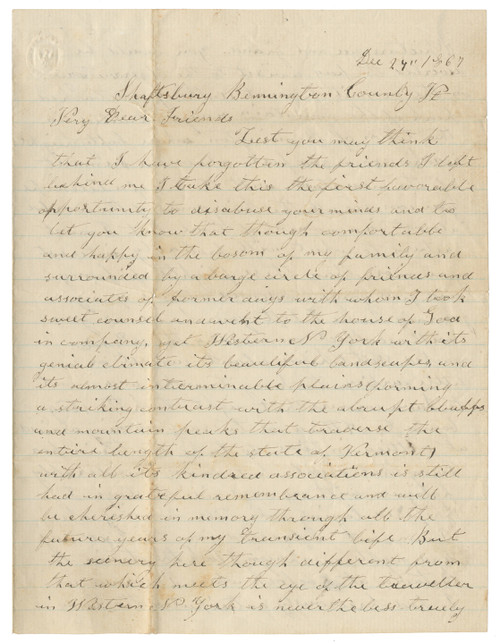
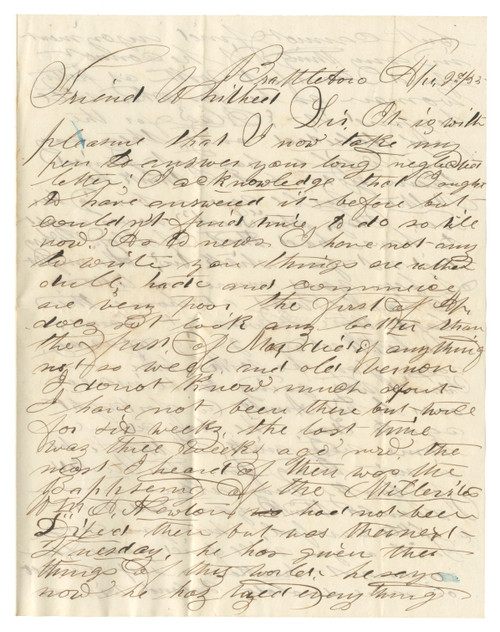
FORT KENAY, A.T. June 8th, 1869 Dear General, Your very kind favor of the 29th inst. arrived safely on the morning of the 6th, by the margaret which brought tickets all right and the scow also. Four mules will be sufficient for our purposes I think, without any other wagon. We have finished the bakehouse and the oven. We shall bake the first batch of bread on Monday next. So far as we are able to judge the oven is a success; it will bake bread for a year or two at any rate. We are getting along with the men's quarters. The walls are up and the sleepers are laid both for the floor and the ceiling. We are now putting up the porch which I hope will be erected before the schooner sails. We expect to put the roof on the quarters next week; any time after the roof is on the quarters may be made tenantable within three or four days after the receipt of the necessary flooring. The Doctor complains that he has no medicines with which to cure the sick. I have directed him to make requisitions for those medicines which the sick need greatly at the present time, expecting, or rather hoping, that you will direct them to be supplied from the hospital at Kodiak. I send by the margaret a man by the name of Hill, cook of schooner "Harney", against whom Capt. Lee has preferred a string of charges. I received Hill on a sworn statement taken in duplicate; a copy will accompany Hill to Kodiak. We know nothing about the case but what the statement contains. I send by Mr. Gifford, who goes down on a visit for a few days, five hundred dollars, currency, subscribed by the men for the purchase of vegetables. I have written a letter to General Simpson asking him to make the purchase. I wish you, General, would take the money and letter, and add to the latter anything that you may deem proper, and forward them by the first trustworthy opportunity, and I shall be greatly obliged. Crawford has been quite unwell for several days, but is now improving slowly. The weather continues fine. We are all greatly indebted to you, General, for your kind consideration in sending us both books and newspapers. We all appreciate it. We are in no hurry whatever for the return of the margaret. She can remain with you a week or ten days just as well as not. For particulars with regard to this post I must refer you to Mr. Teck(?) who will give you a better account of affairs here than I can write; and if he fail, you can call on Mr. Gifford. Hoping, General, that this may reach you enjoying health and happiness, I remain, Very sincerely yours, John W. White P.S. Since writing the above Mr. Crawford has employed Humphry, whose time expires next Monday, as blacksmith at the rate of three ($3) dollars in coin per diem. He is the only man here that can do anything at blacksmithing work. We have old Hughes, but he is so old that he cannot do anything, and I think we cannot do better than to retain Humphry at this rate. I wish you would let me know by return mail whether you approve or disapprove. I should like to have all the men of Battery [—] except the sick and married men, ordered to join their battery. We again send fish. I hope they will keep this time, but very much fear they will not. Yours &c J.W.W.