
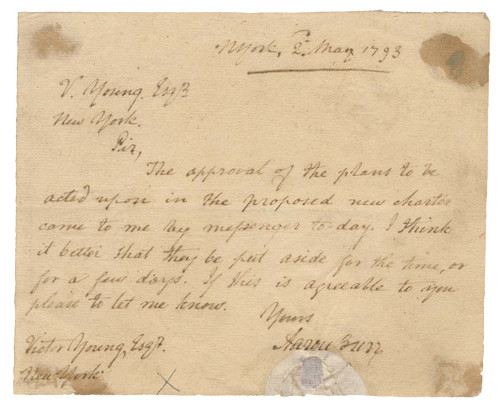
Autograph letter signed “Aaron Burr,” New York, May 2, 1793, addressed to Victor Mounq (or Mowry), discussing approval of plans connected with a “proposed new charter.” Written during Burr's first term as United States Senator from New York and at a pivotal moment in the political and financial development of the early Republic. This intriguing autograph letter bears the signature of Aaron Burr (1756–1836) and was written in New York on May 2, 1793. Though brief in content, the letter concerns the approval of plans relating to a “proposed new charter,” a phrase that places the document squarely within the dynamic world of politics, commerce, and corporate development in the early Federal period. Burr writes: “The approval of the plans to be acted upon in the proposed new charter came to me by messenger today. I think it better that they be put aside for the time, or for a few days…” The letter reflects Burr's characteristic caution and political pragmatism. Rather than rushing action on the proposal, he recommends delay until circumstances become more favorable. Such language is especially noteworthy given Burr's extensive involvement in New York's legal, political, and commercial affairs during the 1790s. The date is significant. In 1793 Burr was serving as a United States Senator from New York, having defeated General Philip Schuyler for the seat two years earlier. At the same time, New York City was rapidly emerging as the nation's leading commercial center. Questions involving charters, corporations, banking institutions, and commercial enterprises occupied an increasingly important place in public life. Burr himself would soon become deeply involved in some of the most consequential corporate ventures of the era. Born in Newark, New Jersey, in 1756, Aaron Burr was the son of a distinguished clerical family and the grandson of theologian Jonathan Edwards. A brilliant student, he entered the College of New Jersey (Princeton) at an unusually young age and graduated with distinction. During the American Revolution Burr served with notable courage and energy. He participated in the expedition to Quebec and later became an officer in the Continental Army, eventually serving on George Washington's staff before assuming independent commands. Although his military career was relatively brief, it established his reputation for intelligence, ambition, and personal bravery. Following the war, Burr built a successful legal practice in New York and quickly rose in state politics. By the early 1790s he had emerged as one of the leading figures of the Democratic-Republican opposition to Alexander Hamilton and the Federalists. His political skills, organizational ability, and personal charisma made him one of the most formidable politicians of his generation. Burr's career reached its apex in 1800 when he was elected Vice President of the United States under Thomas Jefferson. The election produced a constitutional crisis after Jefferson and Burr received an equal number of electoral votes, forcing the House of Representatives to choose between them. Although Jefferson ultimately prevailed, Burr became vice president and remained a major national figure. His reputation, however, became permanently linked to the famous duel with Alexander Hamilton on July 11, 1804, in which Hamilton was mortally wounded. The event shocked the nation and effectively ended Burr's political prospects. He later became involved in the controversial western expedition known as the Burr Conspiracy, resulting in a dramatic treason trial in 1807, though he was ultimately acquitted. Today Burr remains one of the most complex and debated figures among the Founding Generation—admired for his intellect and accomplishments while often overshadowed by the controversies that marked the latter part of his life. This 1793 letter survives from a period before those dramatic events, when Burr stood among the rising political leaders of the new republic. Its reference to a proposed charter is particularly suggestive, reflecting the expanding commercial and institutional development of New York during the Federal era. Documents from this stage of Burr's career are especially desirable because they reveal him as lawyer, legislator, and political strategist rather than as the controversial figure of later years. As a result, the letter offers an appealing glimpse into the practical business and political concerns of one of the most fascinating personalities of the Revolutionary generation. ______________________________________________________________________________________________
New York, 2d May 1793 V. Mounq Esq. New York. Sir, The approval of the plans to be acted upon in the proposed new charter came to me by messenger today. I think it better that they be put aside for the time, or for a few days. If this is agreeable to you please to let me know. Yours Aaron Burr Victor Mounq, Esq. New York.