
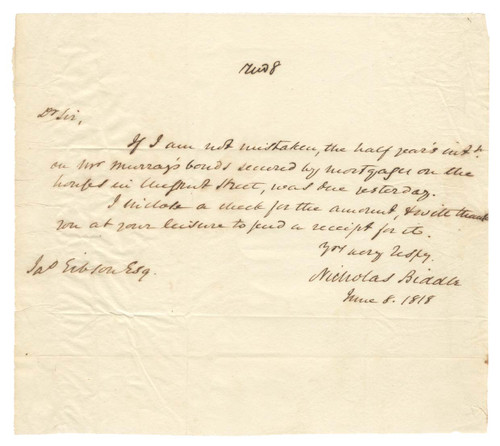
Autograph letter signed “Nicholas Biddle,” dated June 8, 1818, regarding the payment of interest on a mortgage bond. Written during the early years of Biddle's meteoric rise in American finance, only a few years before he became the dominant figure in the Second Bank of the United States and one of the most influential bankers in American history. This concise but revealing financial letter bears the signature of Nicholas Biddle (1786–1844), the celebrated Philadelphia financier, author, diplomat, and future president of the Second Bank of the United States. Written on June 8, 1818, the letter concerns the routine payment of mortgage interest and demonstrates Biddle's personal involvement in the management of his financial affairs during a formative period in his career. Addressed to “Mr. Eustace Esq.”, Biddle writes: “If I am not mistaken, the half year's interest on Mr. Murray's bond secured by mortgage on the houses in Locust Street, was due yesterday.” He further notes: “I inclose a check for the amount & will thank you at your leisure to send a receipt for it.” Although brief, the letter provides an excellent example of the business correspondence of a man who would soon become the most powerful banker in the United States. It reflects the world of urban real estate investment, mortgage financing, and private credit that characterized the expanding economy of the early republic. Born into one of Philadelphia's most distinguished families in 1786, Nicholas Biddle was widely regarded as a child prodigy. He graduated from the College of New Jersey (Princeton) at an exceptionally young age and quickly established himself as one of the most brilliant intellectuals of his generation. In his early twenties he traveled extensively in Europe, served in diplomatic posts, and gained valuable experience in international affairs and finance. By the time this letter was written in 1818, Biddle was already becoming prominent in Philadelphia's financial and political circles. He had served in the Pennsylvania legislature and was actively involved in banking and economic affairs. The nation was entering a period of rapid expansion following the War of 1812, and financial institutions were assuming an increasingly important role in American economic life. Only a few years later, in 1823, Biddle became a director of the Second Bank of the United States, and in 1824 he was elected its president. Under his leadership the Bank emerged as the most important financial institution in the country. Biddle brought remarkable administrative skill, intellectual sophistication, and financial expertise to the position, helping stabilize the national currency and regulate the nation's banking system. Biddle's fame—and eventual notoriety—stemmed largely from the Bank War of the 1830s. President Andrew Jackson viewed the Second Bank as an undemocratic concentration of economic power and sought its destruction. Biddle became Jackson's principal antagonist in one of the defining political struggles of the era. The conflict culminated in Jackson's veto of the Bank's recharter and the eventual demise of the institution, fundamentally reshaping American finance. Despite the controversy, historians generally regard Biddle as one of the most capable bankers in American history. His efforts to impose discipline on state banks, maintain financial stability, and modernize the nation's credit system left a lasting impact on American economic development. This 1818 letter is especially appealing because it predates Biddle's presidency of the Second Bank and captures him during the transitional period between his early public career and his rise to national prominence. Rather than a grand political or financial document, it preserves the everyday workings of credit, mortgages, and personal financial management in the early republic—precisely the world in which Biddle would later become a dominant figure. Autograph letters of Nicholas Biddle are highly sought after by collectors of American financial history, particularly those dating from the years immediately preceding his leadership of the Second Bank. As a result, this document provides both an attractive example of Biddle's handwriting and a tangible connection to one of the most consequential financial minds of nineteenth-century America. ______________________________________________________________________________________________
Sir, If I am not mistaken, the half year's interest on Mr Murray's bond secured by mortgage on the houses in Locust Street, was due yesterday. I inclose a check for the amount & will thank you at your leisure to send a receipt for it. Your very respectfully, Nicholas Biddle June 8, 1818 To Mr Eustace Esq.