

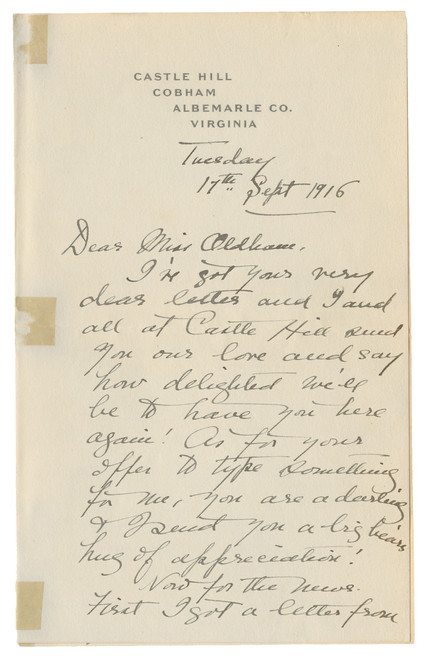
A warm and highly engaging six-page autograph letter signed by celebrated American novelist, playwright, and social figure Amélie Rives Troubetzkoy (1863–1945), written from her famed estate Castle Hill, Cobham, Albemarle County, Virginia, dated September 17, 1916. Penned entirely in Rives Troubetzkoy’s flowing hand, the letter is addressed to “Miss Oldham” and contains extensive discussion of literary criticism, theatrical adaptation, mutual acquaintances, and reactions to one of the recipient’s dramatic works. The author expresses delight at receiving the correspondent’s letter and enthusiastically relays praise from literary and theatrical associates, including comments from “Willy Taversham” in New York and others who had read the play. Particularly notable are the candid literary observations and theatrical commentary, including praise for the work’s dialogue and structure, along with constructive criticism regarding characterization and dramatic development. Troubetzkoy writes that one character “doesn’t care for, and such is life,” while emphasizing the realities of theater and production. The letter vividly illustrates the literary culture of early twentieth-century America and the personal networks surrounding playwrights, publishers, and society intellectuals. Castle Hill itself was a famous artistic gathering place in Virginia, frequented by writers, actors, and prominent cultural figures. A superb literary autograph with substantial content relating to dramatic writing, criticism, and theatrical production. Condition generally very good, with expected mailing folds, minor edge wear, and light toning.
| Transcription: |
Castle Hill Cobham Albemarle Co. Virginia Tuesday 17th Sept 1916 Dear Miss Oldham, I’ve got your very dear letter and I and all at Castle Hill send you our love and say how delighted we’ll be to have you here again! As for your offer to type something for me,—you are a darling & I send you a big hearty hug of appreciation. Now for the news. First I got a letter from Willy Taversham in which he sent you a delightful message as follows: (At least the last part is a message directly to you, but I’ll read you the first part too! Which I very nice.) “I am so glad Elsie is so welcome to you. She deserves every thing you say of her indeed she’s a wonderful ‘kid’. She can fail to shame any (1) British Workmen (2) American Business men, & German Professors AND ALL stenographers in the world, at once! :) We are all as fond of her & even though she has some comic little acquired Southern habit of speech such as ‘youall’ & ‘yours all’, we shall always love her. (Please tell her this!) I do so appreciate her quick response to everything after my wire was sent.” Now for “Cros Roads.” Taversham was in New York where it assumed I do it was read by Julie, Mrs T. Mrs. Mannes, Mrs Brok, & Miss Hall & Troubetskoy. I received a telegram signed by them all: “Thrilled & enthusiastic over your play, its distinction & brilliance. It is a great, living human thing, etc.” Then from Mrs. T. came later this:— “I am known as truly frank. Your story is fine up to end of 2nd Act. Then falls till end of 3rd Act. But last four pages are great.” Then the letters began to come. Taversham also liked into the part of Jack. Thinks Evelyn’s part is the best. Doesn’t like Sara Wheelwright. Wants things generally hurried today, hurry. Today I got a letter from Julie which I have answered sweeply. Frankly, saying that “this playfault” my false name is “Amie Cavendish.” The fact is that I’m far too near to the play yet to judge it with the cold impartiality that one should judge one’s own work. I shall need several months to elapse (I prefer a year!) before I can do that. As I wrote Julie, at present the play may be “a poor thing but mine own” as Touchstone (I think) says.—Whereas if I go to altering it according to the ideas of this & that & the other person it will probably end by being a stale poorer thing & not mine own at all!!! I’m very impressed always, & I’m so anxious right to get this play produced at once, etc etc. While the best thing is for Taversham to give it up & let me try later on a more conventional story and a part preeminently for the leading man. So you see, the 3rd Act which Mr. Taversham thought he’d like, he doesn’t care for, and such is life, & such is the way of the theatre! Bless you dear. I hope you had the most delightful evening at your dance. Yours affectionately, Amélie Troubetzkoy P.S. One of the things I was going to write down for you & didn’t, was that I feared it would make Evelyn’s part too good! Ha!