
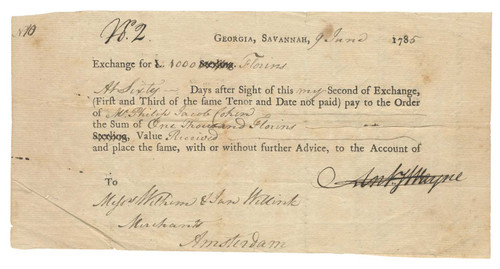
Partially printed and manuscript bill of exchange signed by Major General Anthony Wayne, Savannah, Georgia, June 9, 1785, directing payment of 1,000 florins through Amsterdam merchants. An exceptionally scarce commercial document executed during Wayne's brief postwar residence in Georgia, immediately before his return to national prominence as one of the early Republic's most celebrated military commanders. This handsome international bill of exchange bears the bold signature of Major General Anthony Wayne (1745–1796) and was executed at Savannah, Georgia, on June 9, 1785, just two years after the conclusion of the American Revolution. Drawn upon merchants in Amsterdam, the document orders payment of One Thousand Florins to Philip Jacob Cohen and reflects the transatlantic commercial networks that connected the newly independent United States with European financial markets. The bill reads in part: “Georgia, Savannah, 9 June 1785 … At sixty days after sight of this my second of exchange … pay to the order of Mr. Philip Jacob Cohen the sum of One Thousand Florins…” Addressed to: “Messrs. Wilhelm & Jan Willink, Merchants, Amsterdam,” the document links Wayne directly to the celebrated Dutch banking house of Wilhelm and Jan Willink, among the most important European financiers of the early United States. The Willinks were deeply involved in American public finance, helping arrange loans for the Continental Congress and later for the federal government. Their banking network was critical to the financial stability of the new nation during its formative years. This bill belongs to a fascinating and relatively little-known period in Wayne's life. Following the Revolutionary War, Wayne acquired substantial landholdings in Georgia through grants awarded for military service. In 1784 he relocated to Georgia and became actively involved in plantation management, land speculation, and state politics. Savannah served as his principal base of operations during these years, and documents signed by Wayne from this Georgia period are considerably scarcer than those dating from his military service. The recipient, Philip Jacob Cohen, was almost certainly connected to the substantial Jewish mercantile community of Savannah, one of the oldest and most influential Jewish settlements in North America. The transaction illustrates the cosmopolitan commercial environment of post-Revolutionary Savannah, where American planters, merchants, and international financiers interacted within a growing Atlantic economy. Born in Chester County, Pennsylvania, in 1745, Anthony Wayne emerged as one of the most aggressive and successful combat commanders of the American Revolution. A surveyor and farmer before the war, he entered military service in 1776 and quickly distinguished himself through personal courage, energy, and tactical skill. Wayne participated in many of the Revolution's most significant campaigns, including the defense of New York, the Philadelphia campaign, Monmouth, and operations in the southern theater. His daring nighttime assault on the British fortifications at Stony Point in July 1779 became one of the most celebrated American victories of the war. The success earned him a Congressional gold medal and cemented his reputation for audacity. It was from exploits such as this that he acquired the famous nickname “Mad Anthony,” though the title reflected his bold leadership rather than recklessness. Following the war, Wayne served in both Pennsylvania and Georgia politics before returning to national service in the 1790s. In 1792 President George Washington appointed him commander of the reorganized United States Army. Wayne transformed the frontier army into a disciplined fighting force and achieved a decisive victory over Native confederate forces at the Battle of Fallen Timbers in 1794. That triumph led directly to the Treaty of Greenville (1795) and secured American control over much of the Old Northwest Territory. Wayne died in 1796 while returning east from frontier service, ending a career that spanned the Revolution and the formative years of the Republic. He remains one of the most renowned military figures of the eighteenth century and one of George Washington's most trusted field commanders. This bill of exchange is particularly significant because it documents Wayne not on the battlefield but as a participant in the international commercial world that emerged after independence. Its connection to Savannah, Dutch-American finance, the Willink banking house, and Wayne's postwar Georgia career provides a rare and revealing glimpse into the economic realities faced by Revolutionary officers after the war. Combining a bold signature, international financial context, and an important historical figure, the document represents an exceptional artifact of the early American republic. ______________________________________________________________________________________________
No. 2 Georgia, Savannah, 9 June 1785 Exchange for £1000 Florins At sixty Days after Sight of this my Second of Exchange, (First and Third of the same Tenor and Date not paid) pay to the Order of Mr. Philip Jacob Cohen the Sum of One Thousand Florins Value Received and place the same, with or without further Advice, to the Account of Anthony Wayne To Messrs. Wilhelm & Jan Willink Merchants Amsterdam