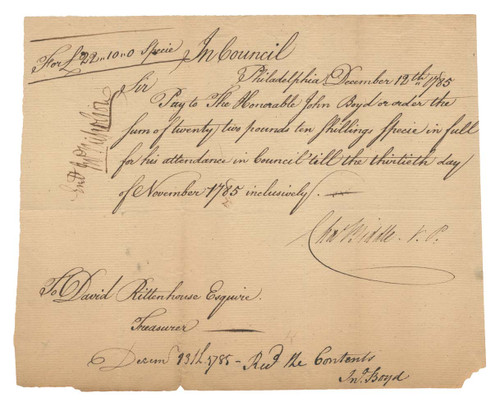
Manuscript pay order directed to Pennsylvania Treasurer David Rittenhouse for payment to Supreme Executive Council member John Boyd, signed by Charles Biddle as Vice President of Pennsylvania.
A handsome and historically significant manuscript pay order issued by the Supreme Executive Council of Pennsylvania during the Confederation era, directing David Rittenhouse, the Commonwealth's Treasurer, to disburse compensation to John Boyd for his attendance as a member of the Executive Council. Dated Philadelphia, December 12, 1785, the document reads:
"Pay to The Honorable John Boyd or order the sum of twenty two pounds ten shillings specie in full for his attendance in Council till the thirtieth day of November 1785 inclusively."
It is signed by Charles Biddle, serving as Vice President of the Supreme Executive Council, and addressed:
"To David Rittenhouse Esquire, Treasurer."
At the foot appears Boyd's receipt acknowledging payment:
"December 13th 1785. Rec'd the contents.
Jno. Boyd."
This document dates from an important transitional period in Pennsylvania government, when the Commonwealth was governed under its radical Constitution of 1776. Executive authority rested not with a governor but with the Supreme Executive Council, headed by a President and Vice President. Routine financial orders such as this one illustrate the orderly administration of government during the fragile years immediately following American independence.
The payment—£22 10s specie—reflects compensation for Boyd's attendance in Council through the end of November 1785, underscoring the practical operation of Pennsylvania's executive government while the United States still functioned under the Articles of Confederation.
David Rittenhouse ranks among the most remarkable scientific minds of eighteenth-century America. Born near Germantown, Pennsylvania, he possessed little formal education but displayed extraordinary mathematical and mechanical abilities from an early age. As a young clockmaker he constructed increasingly sophisticated astronomical instruments, eventually gaining international recognition for his precision craftsmanship and scientific observations.
Rittenhouse achieved lasting fame through his observation of the 1769 Transit of Venus, an event of enormous importance for determining the scale of the solar system. His observations were regarded among the finest made anywhere in the world, earning admiration from European scientists and leading to his election to the American Philosophical Society, of which he later served as president after Benjamin Franklin's death.
During the American Revolution, Rittenhouse devoted his talents to the patriot cause. Pennsylvania entrusted him with the manufacture and inspection of military equipment, including firearms and artillery supplies, while his engineering and organizational abilities proved invaluable to the revolutionary government.
Following independence, he became Treasurer of Pennsylvania, the office reflected in this document. In that capacity he supervised the Commonwealth's finances during the difficult postwar years, processing payments authorized by the Executive Council and maintaining confidence in Pennsylvania's public accounts.
Rittenhouse's reputation for integrity and scientific brilliance led President George Washington to appoint him the first Director of the United States Mint in 1792. Under his leadership the Mint struck the nation's earliest federal coinage, establishing standards of weight and purity that became the foundation of American monetary production. His combination of scientific precision and public service made him one of the most respected figures of the Early Republic.
Thomas Jefferson counted Rittenhouse among the greatest philosophers America had produced, while contemporaries regarded him as the equal of Europe's leading natural scientists.
The order is signed by Charles Biddle (1745–1821), Revolutionary patriot, merchant, and Vice President of Pennsylvania. Biddle had served in the Continental Army before entering public office and became one of Pennsylvania's leading political figures during the Confederation period.
The recipient, John Boyd, was a member of Pennsylvania's Supreme Executive Council. Council members represented the various counties of the Commonwealth and shared responsibility for executive administration during the years before Pennsylvania adopted its present gubernatorial system under the Constitution of 1790.
Financial orders such as this illustrate the practical workings of state government during the formative years of the United States. Before the adoption of the federal Constitution in 1787, the individual states remained the principal engines of governance. Their councils managed finances, paid public officials, supported judicial and administrative functions, and maintained public credit despite the severe economic difficulties following the Revolution.
The document also demonstrates the continued reliance upon specie—gold and silver coin—as the preferred medium for official payments, reflecting the financial instability that characterized the Confederation era before establishment of the federal monetary system.
This manuscript possesses exceptional historical interest through its association with one of America's foremost scientists and public servants.
Official Pennsylvania Supreme Executive Council pay order dated 12 December 1785.
Addressed to David Rittenhouse, one of the greatest scientific figures of colonial and early federal America.
Signed by Charles Biddle, Vice President of Pennsylvania.
Endorsed by Council member John Boyd, acknowledging receipt.
Created during the Confederation period, only two years before the Constitutional Convention.
Connects directly with Pennsylvania's financial administration before the establishment of the United States Constitution and the federal government.
Documents directed to David Rittenhouse in his official capacity as Pennsylvania Treasurer are considerably scarcer than examples relating to his later service as the first Director of the United States Mint. This attractive manuscript therefore represents an excellent intersection of scientific, political, and financial history, linking one of America's greatest Enlightenment figures with the everyday administration of one of the nation's most influential states during the closing years of the Revolutionary era.
also, transcribe the piece
Certainly. The manuscript is highly legible overall, though there are a few flourishes and words that are partially obscured. Below is a diplomatic transcription preserving the original spelling and capitalization as closely as possible. Uncertain readings are indicated in [brackets].
Philadelphia December 12th 1785
Sir
Pay to The Honorable John Boyd or order the sum of twenty two pounds ten shillings specie in full for his attendance in Council till the thirtieth day of November 1785 inclusively.
Chas. Biddle V.P.
To David Rittenhouse Esquire
Treasurer
Endorsement (bottom):
December 13th 1785.
Rec'd the Contents
Jno. Boyd
Upper left:
For £22..10..0 Specie
Left margin (vertical):
Rec'd by Mr Wilson
(Several small accounting marks and filing numbers also appear in the margins.)
Philadelphia December 12th 1785
Sir
Pay to The Honorable John Boyd or order the sum of twenty two pounds ten shillings specie in full for his attendance in Council till the thirtieth day of November 1785 inclusively.
Chas. Biddle V.P.
To David Rittenhouse Esquire
Treasurer
December 13th 1785.
Rec'd the Contents
Jno. Boyd

David Rittenhouse Signed Council Pay Order Philadelphia, 12 December 1785
$450.00
(No reviews yet)
Write a Review
Write a Review
David Rittenhouse Signed Council Pay Order Philadelphia, 12 December 1785
- SKU:
- HZ045