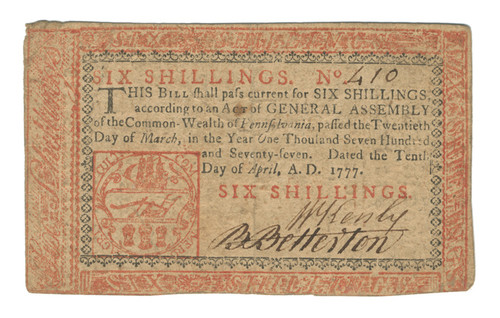
An original issue of The Pennsylvania Packet and General Advertiser, published in Philadelphia on Saturday, November 27, 1779, containing a significant real-time advertisement relating to the confiscated estates of Loyalists and prominently mentioning Ethan Allen. The newspaper includes a public notice announcing the sale of lands forfeited to the Commonwealth, among them property associated with Allen in the disputed New Hampshire Grants (present-day Vermont). The notice reads in part:
“...one large and stately dwelling house, two grist-mills, a saw mill and a paper-mill, with barns, stables and a great number of other buildings of five miles all in excellent order... No. 3. Seventy-eight acres adjoining the above... the property of Ethan Allen...”
The appearance of Allen’s name in a major wartime Philadelphia newspaper provides a fascinating glimpse into the legal and political complexities surrounding land ownership in the northern frontier during the American Revolution. Printed during the fourth year of the war, the newspaper captures the intersection of revolutionary politics, confiscation laws, frontier settlement, and the emergence of Vermont as a distinct political entity.
By 1779 Ethan Allen had already become one of the most celebrated heroes of the American Revolution. His dramatic capture of Fort Ticonderoga in May 1775 made him a household name throughout the colonies. Yet while Allen’s military exploits were widely admired, his legal and political circumstances remained extraordinarily complicated.
For decades prior to the Revolution, settlers in the region known as the New Hampshire Grants had contested New York’s claims to their lands. Allen emerged as the leader of the resistance movement known as the Green Mountain Boys, organizing opposition to New York authorities and defending settlers against competing land claims. During this period Allen was viewed by New York officials as a dangerous agitator and, at times, effectively an outlaw.
The confiscation notice appearing in this newspaper reflects the lingering legal disputes arising from those land controversies. Revolutionary governments throughout the states frequently seized or sold contested properties, particularly those associated with Loyalists or disputed claims. The appearance of Allen’s property in such proceedings demonstrates the unsettled nature of land ownership in the northern frontier even after independence had become the central cause of the colonies.
The newspaper itself was among the most important publications in Revolutionary America. Published in Philadelphia—the political center of the revolutionary movement—it carried domestic news, foreign intelligence, legislative proceedings, military reports, and public notices. The issue appeared only weeks after the failed Franco-American Siege of Savannah and during a period when the war's outcome remained uncertain.
For historians, notices such as this are particularly valuable because they document Allen not as a legendary military figure but as a participant in the everyday legal and economic realities of Revolutionary America. They reveal how frontier disputes, land speculation, and political authority remained deeply intertwined throughout the struggle for independence.
Ethan Allen was one of the most colorful and influential figures of the American Revolution. Born in Litchfield, Connecticut, in 1738, he became a prominent landholder and political leader in the New Hampshire Grants region, where disputes over land titles brought him into conflict with New York authorities.
Allen organized and led the Green Mountain Boys, a militia formed to protect settlers holding New Hampshire land grants against rival claimants backed by New York. His bold leadership made him a symbol of frontier resistance and local self-government.
At the outbreak of the Revolution, Allen achieved lasting fame on 10 May 1775 when he joined Benedict Arnold in the surprise capture of Fort Ticonderoga. The victory provided the Continental forces with desperately needed artillery and marked one of the first significant American successes of the war. Allen's demand that the British surrender “in the name of the Great Jehovah and the Continental Congress” became one of the Revolution’s most famous declarations.
Later in 1775 Allen participated in the invasion of Canada, where he was captured near Montreal and spent nearly three years as a British prisoner. Upon his release and exchange in 1778, he returned to the northern frontier and became deeply involved in efforts to secure recognition for the independent Republic of Vermont.
Allen spent his later years advocating for Vermont's independence and eventual admission to the Union. Although he died in 1789 before statehood was achieved, his efforts laid the groundwork for Vermont's admission as the fourteenth state in 1791. Today he remains one of the most iconic figures in Vermont history and a celebrated hero of the American Revolution.

Ethan Allen. Contemporary Newspaper Appearance in The Pennsylvania Packet and General Advertiser. Philadelphia, 27 November 1779.
$200.00
(No reviews yet)
Write a Review

Write a Review
Ethan Allen. Contemporary Newspaper Appearance in The Pennsylvania Packet and General Advertiser. Philadelphia, 27 November 1779.
- SKU:
- HZ080