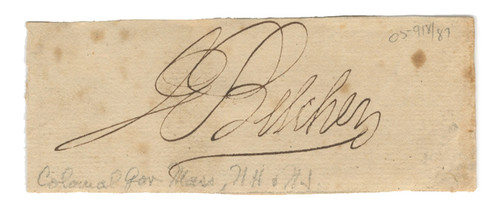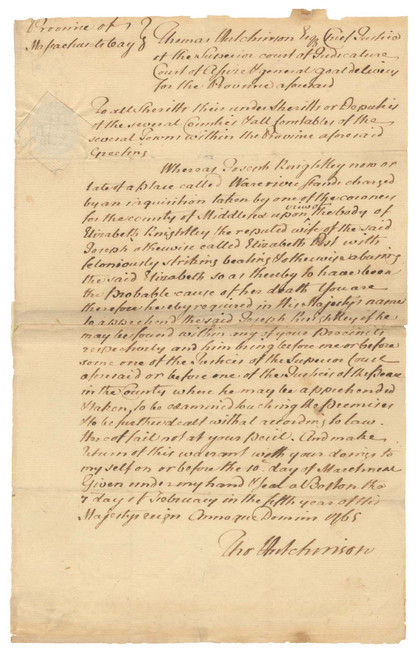


Partially printed and manuscript execution writ signed “Jon. Trumbull Assist.,” Lebanon, Connecticut, March 25, 1765, directing the sheriff or constables of Windham County to satisfy a judgment obtained by Elisha Marsh against Ebenezer Fitch. Issued a decade before the American Revolution by the future wartime Governor of Connecticut. This scarce colonial Connecticut legal document bears the signature of Jonathan Trumbull (1710–1785) in his capacity as an Assistant (member of the Governor's Council and magistrate) of the Colony of Connecticut. Issued at Lebanon on March 25, 1765, the writ orders the sheriff or local constables of Windham County to enforce a judgment recovered by Elisha Marsh of Lebanon against Ebenezer Fitch of Lebanon and to collect the debt, costs, and associated fees according to law. The document exemplifies the routine but essential machinery of colonial justice. Following a judgment entered by confession before Jonathan Trumbull, officers were directed to levy upon the debtor's goods, chattels, or lands sufficient to satisfy the obligation. If adequate property could not be found, the writ authorized the arrest and imprisonment of the debtor until payment was made. The reverse records a partial satisfaction of the judgment, noting payment credited against the debt in February 1764/1765, illustrating the continuing legal process by which debts were enforced in eighteenth-century New England. The date is especially noteworthy. The writ was issued in 1765, one of the most consequential years in colonial American history. Within months, Parliament's Stamp Act would provoke widespread resistance throughout the colonies and help set in motion the chain of events leading to the American Revolution. At the time this document was signed, Jonathan Trumbull was already among Connecticut's most respected public officials and was steadily advancing toward the governorship he would assume four years later. Born in Lebanon, Connecticut, in 1710, Jonathan Trumbull established himself as a successful merchant, legislator, judge, and civic leader. His talents brought him into the colony's highest councils, where he served in a succession of increasingly important offices. In 1769 he was elected Governor of Connecticut, a position he would hold throughout the Revolutionary era. Trumbull occupies a unique place in American history as the only colonial governor to support the Patriot cause and remain in office throughout the Revolution. While royal authority collapsed elsewhere and governors fled, were removed, or remained loyal to the Crown, Trumbull aligned himself firmly with the colonial resistance movement. Under his leadership Connecticut became one of the most important suppliers of troops, food, clothing, arms, and military stores for the Continental Army. George Washington relied heavily upon Trumbull's administrative ability and Connecticut's resources. The governor's extensive correspondence with Washington reveals a relationship of unusual confidence and mutual respect. Tradition holds that Washington affectionately referred to him as “Brother Jonathan,” a nickname that eventually evolved into one of the best-known personifications of the American people. During the Revolution, Trumbull's state earned a reputation as the army's principal supplier. Historians have frequently described Connecticut as the “Provision State,” and much of that success stemmed from Trumbull's organizational skill and tireless attention to military logistics. His contributions were so substantial that he is often regarded as one of the most important civilian leaders of the Revolutionary cause. This document predates those famous achievements by a decade and therefore offers a valuable glimpse into Trumbull's earlier public career. Signed while he was serving as a colonial magistrate and councilor, it illustrates the legal and governmental responsibilities that prepared him for the extraordinary demands of wartime leadership. Colonial Connecticut documents signed by Jonathan Trumbull are highly desirable, particularly examples from the pre-Revolutionary period. This writ combines legal, genealogical, and historical significance while preserving the autograph of one of the most influential governors in American history. As such, it stands as a compelling artifact from the years immediately preceding the Revolution and from the career of the man who would become Washington's most trusted state executive.
______________________________________________________________________________________________
To the Sheriff of the County of Windham or his Deputy, or either of the Constables of the Town of Lebanon within said County, Greeting: Whereas Elisha Marsh of said Lebanon recovered Judgment against Ebenezer Fitch of Lebanon by confession before Jonathan Trumbull Assistant the 16th day of February 1763 for the sum of Thirteen pounds Ten Shillings in lawful Money and Two Shillings costs of suit... These are therefore in His Majesty's Name to command you, that of the goods, chattels or lands of the said Ebenezer Fitch, within your precincts, you cause to be levied and paid unto the said Elisha Marsh the aforesaid sums... And for want of such goods, chattels or lands... you are hereby commanded to take the body of the said Fitch and commit him unto the keeper of the gaol in Windham... Dated at Lebanon this 25th day of March Anno Domini 1765 Jon. Trumbull Assist.
1764 Feby 20th Recd. of Jon. Trumbull Ten pounds seventeen shillings lawful money endorsed on the judgment for part on acct. thereof Elisha Marsh