
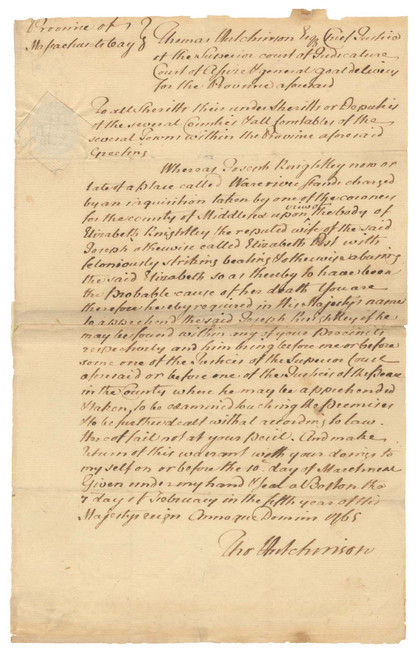
Manuscript legal warrant signed “Tho Hutchinson” by Thomas Hutchinson (1711–1780), Chief Justice of the Superior Court of Judicature of the Province of Massachusetts Bay, issued at Boston on 7 February 1765. The document orders local constables throughout the colony to apprehend Joseph Knightley, accused of causing the death of his wife, Elizabeth Knightley, through repeated physical abuse. Hutchinson directs that Knightley be arrested and brought before a justice for examination concerning the alleged felony. The warrant provides a vivid glimpse into the administration of criminal justice in colonial New England. Acting upon the findings of a coroner’s inquest in Middlesex County, Hutchinson records that Elizabeth Knightley’s death was believed to have resulted from her husband’s “feloniously striking, beating & otherwise abusing” her. The document demonstrates the legal mechanisms available in the mid-eighteenth century for pursuing suspects across county boundaries and reflects the role of the Superior Court in overseeing serious criminal offenses, including homicide. Issued only weeks before the tumultuous events of the Stamp Act crisis transformed colonial politics, the warrant belongs to the final decade of British rule in Massachusetts. It survives as an unusually detailed example of a colonial criminal process document and is especially noteworthy for its association with one of the most consequential and controversial figures in pre-Revolutionary America. The warrant was issued from Boston during a period of increasing political tension between Great Britain and its American colonies. Yet the document concerns a matter of ordinary criminal law rather than politics, illustrating the broad responsibilities of colonial government and courts. Coroners’ inquests served as the principal means of investigating suspicious deaths, and their findings could trigger warrants such as this one. The language of the document reflects eighteenth-century legal practice, whereby officers throughout the province were empowered to search for and arrest accused felons wherever they might be found. The allegation that Knightley caused the death of his wife through repeated abuse provides a rare documentary record of a domestic homicide investigation in colonial America. Such records are comparatively uncommon and offer valuable insight into both family life and criminal prosecution in the eighteenth century. Thomas Hutchinson was one of the most prominent political figures in colonial Massachusetts and among the last royal governors of the province. Born in Boston in 1711 into a prosperous merchant family, he graduated from Harvard College in 1727 and entered public life at an early age. Over the course of his career he served as a member of the Massachusetts House of Representatives, Speaker of the House, Lieutenant Governor, Chief Justice of the Superior Court, and ultimately Governor of Massachusetts Bay. Hutchinson was also a distinguished historian whose History of the Colony and Province of Massachusetts Bay remains an important source for colonial New England. Despite his intellectual accomplishments, he became increasingly unpopular among many colonists because of his steadfast loyalty to the British Crown. His support for imperial policies, including enforcement of parliamentary taxation, made him a principal target of Patriot opposition. During the Stamp Act disturbances of 1765, a mob attacked and destroyed his Boston mansion, scattering his books and manuscripts. In 1774 Hutchinson departed Massachusetts for England, where he spent the remainder of his life. He died in London in 1780 during the American Revolution. Today he is remembered as one of the most important Loyalist statesmen of colonial America and as a central figure in the political conflicts that preceded independence. ______________________________________________________________________________________________
Province of Massachusetts Bay Thomas Hutchinson Esq'r Chief Justice of the Superior Court of Judicature, Court of Assize & General Goal Delivery for the Province aforesaid To all Sheriffs their under Sheriffs or Deputies of the several Counties & all Constables of the several Towns within the Province aforesaid Greeting Whereas Joseph Knightley now or late of a place called Watertown hath charged by an inquisition taken by one of the coroners for the county of Middlesex upon view of the body of Elizabeth Knightley the reputed wife of the said Joseph otherwise called Elizabeth [——] with feloniously striking beating & otherwise abusing the said Elizabeth so as thereby to have been the probable cause of her death. You are therefore hereby required in His Majesty's name to apprehend the said Joseph Knightley if he may be found within any of your Precincts respectively and him bring before me or before some one of the Justices of the Superior Court aforesaid or before one of the Justices of the Peace in the County where he may be apprehended taken, to be examined touching the premises & to be further dealt with as according to law. Hereof fail not at your peril, And make return of this warrant with your doings to myself on or before the 10th day of March next. Given under my hand & seal at Boston the 7th day of February in the fifth year of His Majesty's reign Annoque Domini 1765 Tho Hutchinson