

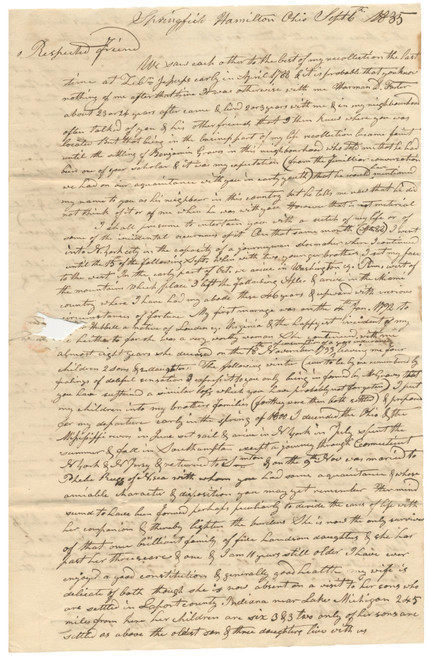
A substantial and content-rich Autograph Letter Signed, dated September 6, 1835, from Springfield, Hamilton (County), Ohio, authored by Luke Foster and addressed to Frederic Halsey. This remarkable four-page letter offers a deeply personal narrative spanning nearly half a century of American life, making it an exceptional primary source for collectors and historians. Key highlights include: Early American migration narrative: The writer recounts leaving New York in 1788 as a journeyman shoemaker, traveling west to Pennsylvania, and ultimately settling in the Miami Valley of Ohio, where he resided for over 40 years—an invaluable firsthand account of early westward expansion. Frontier and family life: Detailed reflections on marriage, loss, and remarriage, including the death of his first wife in 1799 and his second marriage in 1800, alongside insights into raising children in early Ohio and connections to Long Island and Virginia families. Religious thought: A striking rejection of sectarianism, with discussion of Methodist preaching, Quaker theology, and admiration for Robert Barclay and William Penn, illustrating the fluid and individualized religious landscape of the early republic. Political commentary: Extensive and candid observations on early American politics, including: Reflections on the Constitution (1788) Opinions of Washington, Adams, and Jefferson Strong criticism of Andrew Jackson’s administration Condemnation of political “proscription” (spoils system) Support for Martin Van Buren’s opponent, William Henry Harrison Cultural and intellectual references: Mentions of Timothy Flint’s Geography of the Mississippi Valley, indicating engagement with contemporary literature about western development. Condition: Typical of the period, with fold lines, toning, and some areas of wear and paper loss (notably affecting small portions of text), but overall legibility remains strong. Integral address panel present. Summary: A highly desirable and wide-ranging antebellum American letter, combining frontier history, personal narrative, religious independence, and pointed political opinion. Particularly valuable for collectors of Ohio history, early western settlement, and Jacksonian-era political discourse.
| Transcription: |
Respected Friend, We saw each other to the best of my recollection the last time at Litchfield perhaps early in April 1788 & it is probable that you know nothing of me after that time. I was otherwise with one Harman D. Porter about 23 or 24 years after came & lived 20 or 30 years with me & in my neighbourhood often talked of you & his other friends that I then knew where you was located. But that being in the business part of my life recollection became faint until the settling of Benjamin Grover in this neighbourhood who told me that he had been one of your scholars & it was my expectation (from the familiar conversation we had on our acquaintance with you in early youth) that he would mention my name to you as his neighbour in this country but he tells me now that he did not think of it or of me when he was with you. However it is not material. I shall presume to entertain you with a sketch of my life or of some of the incidental occurrences of it. On that same month (April 1788) I went into New York city in the capacity of a journeyman shoemaker where I continued until the 15th of the following September when with two young brothers I set my face to the west. In the early part of Oct. we arrived in Washington Co., Penn., west of the mountains, which place I left the following April & arrived in the Miami country where I have had my abode these 40 years & upwards with various vicissitudes of fortune. My first marriage was on the 11th of Jan. 1792 to Miss Huldah a native of London Co., Virginia & the happiest incident of my life. But she was a very worthy woman. She continued with me almost eight years—she deceased on the 18th of November 1799 leaving me four children, 2 sons & 2 daughters. The following winter (winter to be by me remembered) of feelings of painful sensation I speak it to you only being informed by the memory that you have sustained a similar loss which you have probably not forgotten. I put my children into my brother’s families (partly were then both settled) & prepared for my departure. Early in the spring of 1800 I descended the Ohio & the Mississippi rivers in June or July & arrived in New York in July & spent the summer & fall in Southampton except a journey through Connecticut & returned to N. York & on the 9th Nov was married to Phebe Hugg of L.I., a sister with whom you had some acquaintance & whose amiable character & disposition you may yet remember. Her mind seemed to have been formed perhaps peculiarly to divide the cares of life with her companion & thereby lighten the burdens. She is now the only survivor of that once brilliant family of fine London acquaintances & she has passed her three score & one & I am 11 years still older. I have ever enjoyed a good constitution & generally good health. My wife is delicate of habit though she is now absent on a visit to her sons who are settled in Laporte County Indiana near Lake Michigan 240 miles from here. Her children are six, 3 & 3, two only of her sons are settled as above, the oldest son & three daughters live with us. My oldest son I lost in the year 1810 when I was gone to Long Island. The other three are well settled, two of them have 3 children each the other three. With regard to Religion I renounce sectarianism. I have never considered it necessary or proper to submit my self to the guidance of any sect or order. We attend all religious meetings hoping to cull the good part from all. The Methodists occasionally preach for us so does Mr. Graves sometimes at our house—he lives about 2½ miles from us at Reading where we sometimes go to hear him. But to me the explanations of the Scriptures is more in accordance with that of the Quakers than any other. I prefer the writings of Robert Barclay & William Penn. In Politics I believe I have not differed from that of Suffolk County generally. I commenced my first political reflections with Mr. Bath Smith at Colchester Academy in 1788 on the constitution then submitted. I was that winter studying natural philosophy & I believe did not pay our investigations much attention. In the first (Washington) administrations I had doubts to Adams & was opposed with Jefferson. I was satisfied & all after particularly with J. Q. Adams until the present which I count very corrupt & alarmingly subversive of best principles. If the career of Gen. Jackson & his partizans are not soon checked & reversed I think there will be little left worth preserving. The iniquitous introduction of proscription into our government is extremely reprehensible & that Mr. Van Buren was the first introducer of that system is most certain & of course pledges to sustain & extend it. If elected President (which I hope that is not to be the case) I hope that our candidate Gen. Wm. H. Harrison may obtain that office at the next election. I can recommend him to be a very worthy man. I have been acquainted with him nearly 40 years nearly all of which time he has held some important office & in no instance has he been charged with want of fidelity or seeking any advantage to himself or ever charged with committing a blunder in any form or manner. I dwell with much particularity on this last article because it is matter of great excitement & I think deservedly so. In relation to the geography & improvements of this country I refer you to Timothy Flint’s Geography of the Mississippi Valley. I write to elicit an answer. I do not expect to be able to give you any profitable instruction. But from our early acquaintance & the friendly intimacy I again solicit you in the freedom. I trust my sheet will not be unacceptable. Your Friend Luke Foster