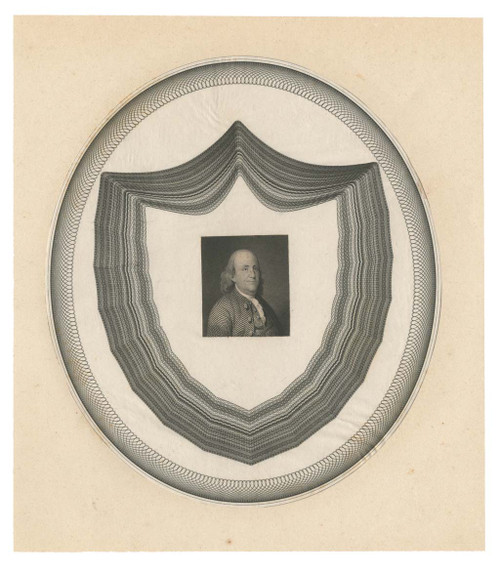
Decorative engraved portrait of Benjamin Franklin surrounded by an elaborate engine-turned guilloché design, likely produced as a specimen or commemorative engraving inspired by early American banknote and security-printing traditions.
This striking print combines a finely engraved portrait of Benjamin Franklin (1706–1790) with an intricate geometric border composed of interlacing engine-turned patterns known as guilloché work. The portrait, based upon one of the familiar late-life likenesses of Franklin, appears at the center of a complex shield-like ornamental framework enclosed within a circular border. The precision and mathematical regularity of the design reflect techniques developed for banknotes, securities, and official documents during the eighteenth and nineteenth centuries to deter counterfeiting.
At first glance the image appears almost abstract, yet its purpose is deeply connected to Franklin's own legacy. The elaborate surrounding ornament resembles the anti-counterfeiting patterns that became a hallmark of American currency and financial engraving. Franklin himself was among the earliest and most innovative printers in colonial America and devoted considerable attention to the security features of paper money. The juxtaposition of his portrait with sophisticated engraved line work makes this piece both a tribute to Franklin and a celebration of the graphic arts he helped pioneer.
The central portrait presents Franklin in his mature years, wearing the plain attire and composed expression associated with his international reputation as philosopher, statesman, and man of science. Surrounding him, the engraved framework demonstrates the remarkable skill of the engraver, whose carefully repeated lines create optical depth and movement. Such designs required specialized machinery and extraordinary technical expertise, making them among the most impressive achievements of nineteenth-century printmaking.
Few figures loom larger in American history than Benjamin Franklin, whose life encompassed science, printing, diplomacy, politics, and public service. Born in Boston in 1706, Franklin apprenticed in his brother's printing shop before settling in Philadelphia, where he established himself as one of the most successful printers and publishers in colonial America.
Franklin's Pennsylvania Gazette became one of the most influential newspapers in the colonies, while his annual publication, Poor Richard's Almanack, made him a household name. Beyond printing, he pursued scientific investigations that earned international acclaim. His experiments with electricity—including the famous kite experiment—helped establish the modern understanding of electrical phenomena and brought him recognition throughout Europe.
Franklin was also among the foremost civic leaders of colonial America. He helped found institutions that became central to Philadelphia's cultural and intellectual life, including the Library Company of Philadelphia, the American Philosophical Society, and what would later become the University of Pennsylvania.
During the American Revolution, Franklin emerged as one of the indispensable architects of independence. He served on the committee that drafted the Declaration of Independence in 1776 and later became the United States' most successful diplomat. As American minister to France, he secured crucial French military and financial support that helped ensure victory over Great Britain. He subsequently participated in negotiating the Treaty of Paris (1783), which formally recognized American independence.
Remarkably, Franklin was the only Founding Father to sign the Declaration of Independence, the Treaty of Alliance with France, the Treaty of Paris, and the United States Constitution, making him uniquely present at each major stage of the nation's founding.
This engraving is especially appropriate as a tribute to Franklin because of his pioneering work in printing and currency production. During the colonial period he printed paper money for several colonies and devised innovative anti-counterfeiting techniques, including the use of detailed nature prints made from leaves. These experiments anticipated later developments in security engraving and banknote design.
By the nineteenth century, engravers employed increasingly sophisticated guilloché patterns like those seen in this print to protect financial instruments from forgery. Such ornament became a defining feature of American banknotes, stock certificates, and government securities. Franklin's portrait frequently appeared on these documents because of both his national stature and his historic connection to the printing trade.
This piece occupies a fascinating intersection between portraiture, graphic design, and financial history. More than a simple likeness of Franklin, it reflects the evolution of American engraving and the technological innovations that transformed the production of secure printed documents. The intricate geometry surrounding the portrait serves as a visual reminder of the craftsmanship that underpinned the nation's banking and commercial systems during the nineteenth century.
As both an homage to Benjamin Franklin and an example of the engraver's art, the print embodies themes central to Franklin's own life: ingenuity, technical mastery, public service, and the power of the printed image. It stands as an elegant tribute to one of the most accomplished figures in American history and to the sophisticated printing traditions that grew from the foundations he helped establish.

Benjamin Franklin Engraved Portrait with Guilloché Security Border
$2,530.00
(No reviews yet)
Write a Review
Write a Review
Benjamin Franklin Engraved Portrait with Guilloché Security Border
- SKU:
- HZ072