
Late eighteenth or early nineteenth century
Engraving on paper.
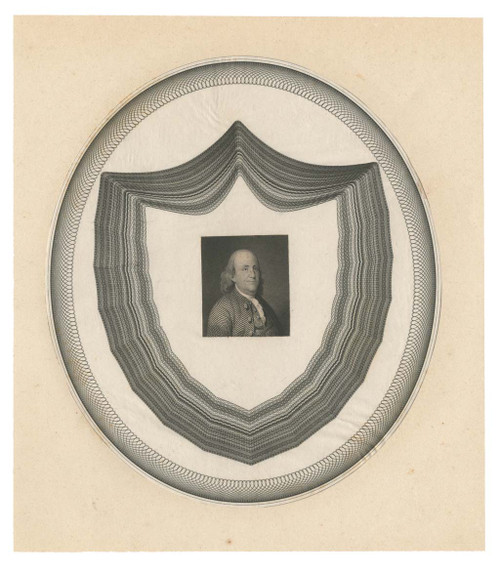
This unusual and visually striking engraved portrait depicts John Jay, one of the principal architects of the early American republic, enclosed within an elaborate geometric framework composed of concentric radiating guilloche patterns. The intricate network of interlaced lines creates a starburst-like medallion surrounding Jay's bust-length portrait, recalling the sophisticated anti-counterfeiting devices employed on early banknotes, securities, government certificates, and engraved financial documents.
At the center appears a finely engraved likeness of Jay in contemporary dress, his hair tied in the fashion of the Revolutionary period. The surrounding ornamental design is remarkable for its complexity, consisting of multiple layers of geometric lathe-work and engine-turned ornament. Such patterns became increasingly important during the late eighteenth and early nineteenth centuries as engravers sought methods to deter forgery and elevate the aesthetic sophistication of official printed documents.
The image likely functioned either as a commemorative portrait vignette, a specimen of security engraving, or a component intended for incorporation into a larger engraved financial or governmental document. The combination of patriotic portraiture and elaborate guilloche work reflects the growing association between national identity, public credit, and the graphic arts in the early United States.
Following the American Revolution, the new republic faced the challenge of establishing credible institutions of government and finance. Engraved portraits of leading statesmen frequently appeared on certificates, bonds, banknotes, and commemorative publications. Such imagery reinforced public confidence while celebrating the founders of the nation.
At the same time, advances in engraving technology led to increasingly elaborate geometric designs. Guilloche ornament—created through repetitive mathematical curves and interwoven lines—served both decorative and practical purposes. Beyond their visual appeal, these designs were difficult to reproduce accurately and therefore offered protection against counterfeiters.
The present image reflects this intersection of patriotism, portraiture, and financial security printing. Whether intended as a proof, presentation engraving, or component of a larger work, it embodies the sophisticated visual language that emerged around public authority and national identity in the early republic.
John Jay was among the most important founders of the United States, though his contributions are often overshadowed by those of Washington, Jefferson, and Hamilton.
Born in New York City in 1745 into a prosperous merchant family of Huguenot descent, Jay trained as a lawyer and quickly became involved in colonial politics during the imperial crisis preceding the Revolution. Initially favoring reconciliation with Great Britain, he ultimately became a leading advocate of American independence.
During the Revolutionary era he served as:
Delegate to the First and Second Continental Congresses
President of the Continental Congress (1778–1779)
Minister to Spain
One of the American commissioners who negotiated the Treaty of Paris (1783) ending the Revolutionary War
Together with Alexander Hamilton and James Madison, Jay authored several of the influential essays known collectively as The Federalist Papers, written to support ratification of the United States Constitution.
In 1789 President George Washington appointed Jay as the first Chief Justice of the United States, making him the inaugural head of the federal judiciary. His tenure helped establish the authority and structure of the Supreme Court during its formative years.
Jay later served as Governor of New York from 1795 to 1801, where he supported gradual emancipation and signed legislation that initiated the eventual abolition of slavery in the state.
Among his most controversial achievements was the negotiation of Jay's Treaty with Great Britain in 1794, an agreement that preserved peace between the two nations during a period of intense international tension.
He retired from public life after declining further national office and died in 1829, by then one of the last surviving major founders of the United States.

John Jay (1745–1829) Decorative Engraved Portrait Medallion / Security-Style Vignette
$0.00
(No reviews yet)
Write a Review

Write a Review
John Jay (1745–1829) Decorative Engraved Portrait Medallion / Security-Style Vignette
- SKU:
- HZ022


Jay Cooke, Jr. As Trustee
$250.00
