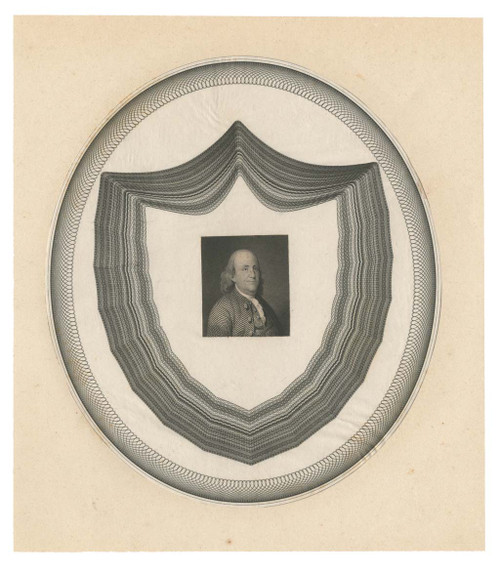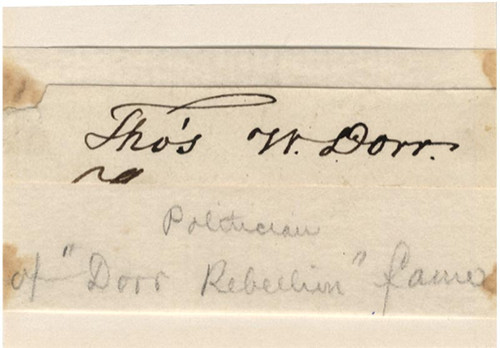
Autograph Signature of Thomas W. Dorr (1805–1854), leader of Rhode Island’s Dorr Rebellion, attractively matted with a contemporary engraved portrait.
This display piece centers on a scarce autograph signature of Thomas Wilson Dorr, one of the most controversial and significant reformers in nineteenth-century American political history. The signature, neatly clipped from a contemporary document and reading “Thomas W. Dorr,” is paired with an engraved portrait depicting Dorr in the years surrounding the constitutional struggle that would make him a national figure. Together, the portrait and autograph commemorate a man whose campaign for expanded suffrage helped transform democratic participation in the United States.
The autograph is particularly desirable because Dorr's political career was brief, tumultuous, and ultimately tragic. Unlike many nineteenth-century politicians who left behind extensive correspondence and public papers, Dorr's active public life was concentrated within a few dramatic years. As a result, authentic signatures and manuscript material relating to him are encountered far less frequently than those of many contemporaries.
Born in Providence, Rhode Island, on November 5, 1805, Thomas Wilson Dorr came from a prosperous mercantile family and received an elite education. He attended Phillips Exeter Academy before entering Harvard College, from which he graduated in 1823. After studying law, he entered public life and served in the Rhode Island General Assembly. Though initially aligned with the state's political establishment, Dorr gradually became convinced that Rhode Island's colonial charter government had become fundamentally undemocratic.
At the heart of the controversy was Rhode Island's continued reliance on its 1663 colonial charter, which restricted voting rights largely to property-owning white men. By the 1830s and 1840s, rapid industrialization had created large populations of wage earners who paid taxes and contributed to the state's economy but possessed no political voice. Reformers increasingly demanded a modern constitution and broader suffrage.
Dorr emerged as the movement's most effective and determined leader. In 1841 he helped organize the People's Convention, which drafted a new constitution extending voting rights to a far larger segment of the population. When the charter government refused to recognize the reform effort, supporters held their own elections, and Dorr was elected governor under the so-called People's Constitution.
The resulting conflict, known as the Dorr Rebellion (1841–1842), produced one of the most important constitutional crises in antebellum America. For a brief period Rhode Island possessed two rival governments, each claiming legitimacy. Although Dorr's movement enjoyed widespread popular support, the charter government retained military backing and federal recognition. After a failed attempt to assert authority by force, Dorr fled the state.
Returning in 1843, he was arrested, tried for treason against Rhode Island, and sentenced to life imprisonment at hard labor. The severity of the punishment shocked many Americans and transformed Dorr into a symbol of democratic reform. Public pressure eventually led to his release in 1845 and restoration of civil rights. More importantly, many of the reforms he championed were ultimately adopted, including expanded suffrage and a more representative constitutional system.
The controversy also generated the landmark Supreme Court case Luther v. Borden (1849), in which the Court ruled that questions regarding the legitimacy of competing state governments constituted political rather than judicial questions. The decision remains a foundational precedent in American constitutional law.
Although his health was permanently damaged by imprisonment and political persecution, Dorr lived long enough to witness the triumph of many of the principles for which he had fought. He died in Providence on December 27, 1854, at the age of forty-nine.
Today Thomas W. Dorr occupies a unique place in American history. Neither a military hero nor a national officeholder, he nevertheless helped redefine the meaning of popular sovereignty in the decades between the Revolution and the Civil War. Historians increasingly regard the Dorr Rebellion as a critical chapter in the expansion of American democracy and a precursor to later struggles over voting rights and political representation.
This attractive autograph display preserves the signature of a man whose name became synonymous with democratic reform. Paired with a contemporary engraved likeness, it serves as a compelling reminder of one of the most dramatic constitutional battles in nineteenth-century America and of the reformer who stood at its center.

Thomas Wilson Dorr Signature Cut with Engraved Portrait
$450.00
(No reviews yet)
Write a Review

Write a Review
Thomas Wilson Dorr Signature Cut with Engraved Portrait
- SKU:
- HZ070