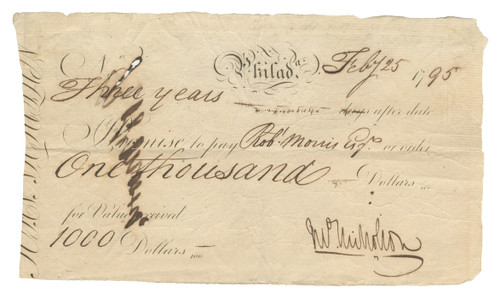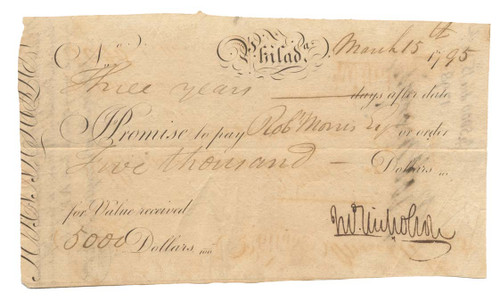


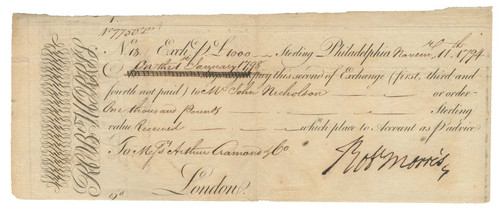
A striking financial manuscript signed by Robert Morris, the celebrated “Financier of the American Revolution,” executed in Philadelphia on 2 May 1795 at the height of the speculative land boom that would ultimately consume the fortunes of many of the new nation's most prominent businessmen. The note reads, in part, “Three years after date I promise to pay to Mr. John Nicholson or Order Three thousand five hundred Dollars,” and bears Morris’s large and characteristic signature. On the reverse appears the endorsement of John Nicholson, Morris’s principal partner in a vast network of land and financial ventures. The document was created during one of the most ambitious periods of American economic expansion. In the years following the Revolution, Morris, Nicholson, and their associates acquired enormous tracts of western lands, convinced that population growth and national development would generate immense profits. These transactions required a constant circulation of notes, bonds, mortgages, and bills of exchange, creating a sophisticated financial system that foreshadowed modern American capital markets. This note represents a direct artifact of that speculative enterprise. Executed in 1795 and payable three years later, it dates from the very eve of the financial collapse that became known as the Panic of 1796–1797. As credit tightened and land values declined, the elaborate network of obligations created by Morris and Nicholson unraveled. Both men eventually faced financial ruin, making surviving instruments from this period particularly evocative reminders of both the opportunities and dangers of the early American economy. Unlike formal government documents associated with Morris’s public career, this note illustrates the private financial world in which the leading founders operated. It offers a tangible connection to the speculative ventures that shaped the nation's economic development during the Federal era. Robert Morris was among the most influential figures of the American Revolution and the early United States. Born in Liverpool, England, he emigrated to Pennsylvania as a young man and became one of colonial America's most successful merchants. During the Revolution he served in the Continental Congress and became one of only two men to sign the Declaration of Independence, the Articles of Confederation, and the United States Constitution. Morris's greatest contribution came as Superintendent of Finance from 1781 to 1784. At a time when the Continental government was nearly bankrupt, he reorganized public finances, secured vital loans, and used his personal credit to supply the Continental Army. His efforts were instrumental in sustaining the war effort during its decisive final phase, earning him the enduring title “Financier of the Revolution.” Following independence, Morris remained one of America's leading businessmen and financiers. He helped establish the Bank of North America, advocated for a strong national financial system, and became deeply involved in western land speculation. His partnership with John Nicholson and James Greenleaf led to the acquisition of millions of acres of land across the expanding republic. The collapse of the land market after 1796 proved catastrophic. Burdened by enormous debts, Morris was imprisoned in Philadelphia's Prune Street Debtors' Prison from 1798 to 1801. Although his later financial downfall overshadowed his achievements for many years, historians now recognize Morris as one of the indispensable architects of American independence and the nation's early financial system. ______________________________________________________________________________________________
Three years after date I promise to pay to Mr. John Nicholson or Order Three thousand five hundred Dollars for value received. Philada. May 2d 1795 Dollars 3500 Robt Morris The reverse is faint, but appears to read: John Nicholson [additional endorsement] Tho. Fitzsimons