

An important and highly evocative early American financial document directly connected to Robert Morris (1734–1806), the celebrated financier of the American Revolution and one of the most influential economic figures of the founding era. The document consists of a substantial $3,000 promissory note, dated Philadelphia, March 15, 1795, payable three years after date, together with a formal notarial protest executed on March 17, 1798, when payment was demanded and refused. The note reads in part: “Three years after date I promise to pay Robert Morris Esq. or order Three Thousand Dollars… for value received…” and is signed by John Nicholson, Morris's longtime business associate and partner in a number of ambitious land-speculation ventures. The reverse bears Morris's endorsement and the notarial certification records that payment was demanded at Nicholson's counting house but that no payment was forthcoming. The document survives from one of the most dramatic financial collapses in the history of the early Republic. During the 1790s Morris and Nicholson became deeply involved in vast land investments extending across Pennsylvania and the western territories. Their projects were financed through extensive borrowing and the circulation of promissory notes such as the present example. As land values failed to rise quickly enough to support their obligations, the speculative empire unraveled. By 1798 both men faced severe financial distress, and within a short time Morris—the man once hailed as the nation's financial savior—would be confined in debtor's prison. The note was executed during the feverish speculative boom that followed the establishment of the federal government under the Constitution. Optimism regarding western settlement and rising land values encouraged many of the nation's wealthiest investors to acquire enormous tracts of land on credit. Robert Morris stood at the center of this movement. Together with John Nicholson and James Greenleaf, he participated in some of the largest land transactions in American history. The ventures required a constant flow of notes, endorsements, and obligations. The present document represents one such instrument and provides direct evidence of the financial mechanisms that fueled the speculative economy of the 1790s. The attached notarial protest, dated March 17, 1798, is particularly significant. It formally records the failure of Nicholson to satisfy the debt upon maturity and constitutes a legal step in preserving Morris's rights against the maker and any endorsers. Such protests were routine in commercial practice, but in this case they foreshadow the spectacular collapse of the Morris-Nicholson land empire and the financial panic that followed. The irony is striking: the man who had once financed the American Revolution now found himself pursuing payment on private obligations while his own finances deteriorated beyond recovery. Robert Morris was one of the principal architects of American independence and among the most important financiers in United States history. Born in Liverpool, England, he immigrated to Pennsylvania as a youth and entered the mercantile trade, eventually becoming one of the wealthiest businessmen in British North America. During the American Revolution, Morris used both his fortune and his credit to sustain the Patriot cause. As a member of the Continental Congress, he signed the Declaration of Independence, the Articles of Confederation, and the United States Constitution, making him one of only two men to sign all three foundational documents of the nation. In 1781 Congress appointed him Superintendent of Finance, effectively making him the first national finance minister. Morris reorganized the government's finances, secured loans from domestic and foreign sources, and helped fund the Yorktown campaign that brought the war to a successful conclusion. His efforts earned him the title “Financier of the Revolution.” Following the war, Morris served as a United States Senator from Pennsylvania and remained one of the country's most influential businessmen. Yet his later years were overshadowed by speculative ventures that proved unsustainable. By 1798–1799 his financial empire collapsed, and in 1798 he was imprisoned for debt in Philadelphia's Prune Street Debtors' Prison, where he remained until federal bankruptcy legislation enabled his release in 1801. Despite this tragic ending, Morris remains one of the indispensable figures of the American founding. Without his financial leadership, the Revolution's successful conclusion would have been far less certain. ______________________________________________________________________________________________
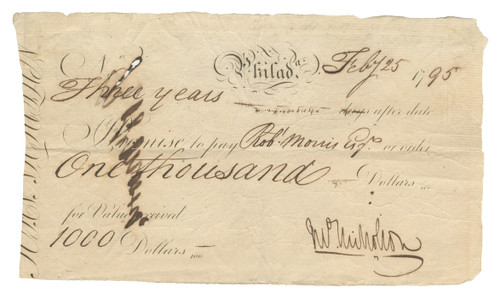
Phila. March 15th 1795 Three years after date I Promise to pay Robt. Morris Esqr. or order Three Thousand Dollars for Value received 3000 Dollars W. Nicholson Vertical endorsement: Robert Morris Notarial notation: Phila. March 17, 1798 This note was this day presented to John Nicholson for payment & payment refused for [want of funds?] registered in my office in book A. Folio 60. Nich. Diehl, Notary Public 1798 Additional notation: $3000 and Int. 1798 BE IT KNOWN, That on the Day of the Date hereof I NICHOLAS DIEHL, junr., Notary Public for the Commonwealth of Pennsylvania, by lawful Authority duly commissioned and qualified, residing in the City of Philadelphia, in the said Commonwealth, at the Request of Mr. James Warrington went to the counting House of John Nicholson, Drawer of the Original Promissory Note whereof a true Copy is on the other side in Order to demand Payment thereof and found the same shut and no Person there to answer or pay the said Note: Wherefore I left Notice of the Nonpayment thereof at the counting House of Robert Morris the Endorser — Whereupon I the said Notary at the Request aforesaid, have and do hereby solemnly Protest against the Drawer & Endorsers of the said Promissory Note and all others concerned for all Exchange, re- Exchange, Costs, Damages and Interest suffered and to be suffered, for want of Payment thereof. Thus Done and Protested at Philadelphia aforesaid, the Seventeenth Day of March 1798. In Testimony whereof I have hereunto set my Hand, and affixed my Notarial Seal the Day and Year above written. Nich. Diehl Jr. Notary Public