

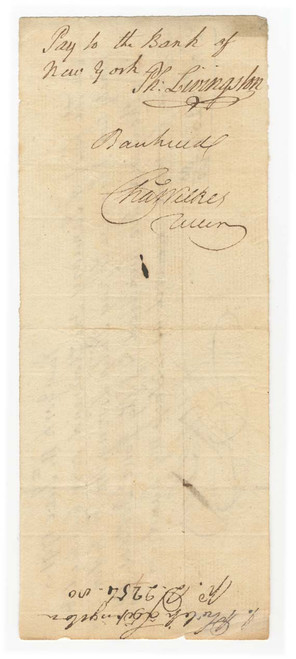
Manuscript signed promissory note with endorsement on verso. Ink on laid paper. This handsome financial instrument, dated New York, 11 June 1791, is a signed promissory note executed by Nicholas Low, one of the most prominent merchants and financiers of the early American republic. In the document, Low promises to pay Philip Livingston the substantial sum of $2,254.00 specie on 1 January 1792, reflecting a significant commercial transaction in the years immediately following the adoption of the United States Constitution. The note reads in part: “On the first of January One thousand seven hundred & ninety two, I promise to pay Philip Livingston or Order Two thousand two hundred & fifty four Dollars specie for value received…” The reverse bears Livingston’s endorsement directing payment to the Bank of New York, illustrating the increasingly sophisticated financial practices emerging in the new nation. Such negotiable instruments served as essential tools of commerce in an era when hard currency was often scarce and mercantile credit networks formed the backbone of American business. The document dates from a pivotal moment in American economic history. Only months earlier, Congress had established the First Bank of the United States, while Treasury Secretary Alexander Hamilton was implementing his ambitious program to stabilize federal finances and promote commercial growth. New York, then serving as the nation’s principal financial center, was home to an elite network of merchants, bankers, and investors whose activities helped shape the economic foundations of the republic. This note reflects that world of credit, capital, and personal reputation upon which early American commerce depended. Nicholas Low (1739–1826) was among the wealthiest and most influential businessmen of post-Revolutionary New York. Born in New Jersey and established in New York City before the Revolution, Low developed extensive mercantile interests that expanded dramatically after American independence. He became deeply involved in banking, land speculation, and international trade, accumulating one of the largest fortunes in the United States. A committed Federalist, Low maintained close associations with many of the leading political and financial figures of the era. He served as a director of the Bank of New York, founded by Alexander Hamilton, and later represented New York in the United States Congress from 1789 to 1793. His business dealings linked him to many of the most powerful mercantile families in the country, including the Livingstons, Morrises, and Schuylers. Low also participated in major land development ventures, particularly in upstate New York, where large tracts of former frontier lands became objects of intense speculation during the 1790s. His success exemplified the rise of a new American financial elite whose wealth was built not merely on trade but on banking, credit, and investment. The payee, Philip Livingston (1741–1787?)—or more likely a member of the extensive Livingston mercantile family represented through estate or business interests—belonged to one of New York’s most powerful dynasties. The Livingstons occupied a central place in the political, commercial, and social life of colonial and early national America. Family members served as signers of the Declaration of Independence, governors, diplomats, judges, and major merchants. The endorsement to the Bank of New York further demonstrates how elite merchant families increasingly relied upon institutional banking rather than solely personal credit arrangements. Such endorsements transformed private obligations into negotiable financial assets, facilitating commerce and investment across the expanding republic. ______________________________________________________________________________________________
New York 11th June 1791 On the first of January One thousand seven hundred & ninety two, I promise to pay Philip Livingston or Order Two thousand two hundred & fifty four Dollars 00/100 specie for value received as Witness my hand Doll. 2254 : 00/100 N. Low Pay to the Bank of New York Ph. Livingston Bankhud Philip Livingston